
The development consent arrives, and the instinct is to book the excavator. In New South Wales that instinct is wrong, and expensively so. A consent authorises the development; it does not authorise the building work. That requires a construction certificate, and the certificate is not issued until a specific set of conditions has been dealt with — several of which are about money you may not have budgeted at that point.
The deal question: what has to be true before the site is lawfully opened?
The NSW Department of Planning, Housing and Infrastructure guide to the post consent process is direct: without a construction certificate it is unlawful to start any building work, even if you have development approval. The certificate confirms that the detailed construction plans and specifications are consistent with the development consent and comply with the Building Code of Australia, and that the consent conditions required to be satisfied before a construction certificate is issued have been met.
Some work does not need one. The NSW Planning Portal's post consent page records that a construction certificate is not required for building work that is exempt or complying development, or for Crown building work.
The conditions are grouped by stage, and one group is about payment
Standard notices of determination group conditions under headings such as general conditions, before issue of a construction certificate, before building work commences, during building work, before issue of an occupation certificate, and occupation and ongoing use. The Department's guide advises applicants to liaise with their building team and certifier so each condition is satisfied at the right stage.
The group that matters most to a feasibility is the second one. The guide notes that local infrastructure contributions — the section 7.11 or 7.12 contributions in your conditions — are generally required to be paid prior to the issue of the construction certificate. That single sentence moves a five or six figure sum into a very specific point in your cash flow.
The charges that arrive before the certificate
Four categories show up at this gate, and they should be in your feasibility from the start.
- Local infrastructure contributions. Charged by councils to fund local infrastructure, and generally payable before the certificate is issued. Some councils will accept works-in-kind or land dedication in lieu of a monetary contribution, which is a negotiation to have early, not late.
- The Housing and Productivity Contribution. Applies to certain new residential development in the Greater Sydney, Illawarra Shoalhaven, Lower Hunter and Central Coast regions, and can be paid as a monetary contribution or delivered as infrastructure. It is regional, not statewide — check whether your site is in a region where it applies.
- Water and sewer contributions. Section 64 of the Local Government Act 1993 (NSW) allows councils and water utilities to levy developer contributions for growth-related water and sewer infrastructure. Rates differ by location and can be significant on a subdivision.
- The long service levy. Applies to NSW building and construction projects of $250,000 or more including GST, at 0.25% of the total cost of the work, and must be paid before the certificate is issued. It is small in percentage terms and easy to overlook entirely.
The Department's guide also lists other matters that may have to be resolved before a certificate issues, including the provision of security deposits, BASIX energy and water requirements, any conditions requiring modifications to the development, and specialist details or reports the conditions call for.
The second gate: appointing a certifier and giving notice
Getting the certificate is necessary but not sufficient. Before building work starts you must appoint a principal certifier — the person who will issue the occupation certificate — and the appointment must be made by the landowner before work commences. You then submit an intention to commence work with two days' notice.
This is where an optimistic programme falls over. The certificate and the certifier appointment are separate steps, both sitting between "consent granted" and "first day on site". If your builder's programme assumes the site is open the week after consent, it is built on an assumption that will not hold.
The checks a capable student would run
- Pull out every pre-certificate condition. Read the consent and list each condition under "before issue of a construction certificate", with the figure and the evidence it requires.
- Confirm which contributions apply to your site. Local contributions are council-specific; the Housing and Productivity Contribution is region-specific; water and sewer contributions depend on your location and utility.
- Reconcile the certificate cost against your feasibility. If the contribution figures in your model came from an early estimate, refresh them against the current contributions plan and the assessed development.
- Line up the certifier early. Confirm registration class and current insurance before you appoint, and get the appointment in place so it is not the step that delays the start.
- Diarise the notices. Two days' notice before starting work is a small item that can be missed in a busy week, and a missed notice is a compliance problem on a site you have just opened.
The trap: starting work on a consent alone
The Department's advisory note records the consequence clearly. Works undertaken without a construction certificate are unauthorised, and you will not be able to obtain an occupation certificate for those works. That is the trap: the work looks complete, the certifier cannot certify it, and the remedy involves exposing, removing or re-approving building work on a finished structure. It is a far more expensive problem than the contribution that was waiting to be paid.
What you do not have to work out alone
You are not expected to interpret the certification requirements or negotiate the contributions yourself. Your building surveyor or accredited certifier issues the certificate and confirms exactly which conditions must be satisfied before it can be issued; a quantity surveyor or your builder prices the works those conditions relate to; and your accountant or finance broker confirms how the contribution and levy payments sit in your project cash flow. Your job is to know that these payments and appointments come before the start, and to have them funded and scheduled before the builder arrives.
Sources and boundaries
Sources checked 5 October 2026. Jurisdiction and limits: This guide is focused on New South Wales. The contributions and certification framework described is the NSW framework under the Environmental Planning and Assessment Act 1979 and the Environmental Planning and Assessment (Development Certification) Regulation 2021. The Housing and Productivity Contribution applies only in defined regions of the state, and contribution amounts are set council by council and plan by plan. Other states and territories use different certificates and charges. Confirm the position for your site before relying on it.
- NSW Department of Planning, Housing and Infrastructure — Your guide to the post consent process. Used for: Explains what a construction certificate verifies, that it is unlawful to start building work without one even with DA approval, the cases where one is not required, the standard staged condition headings, that an intention to commence work requires two days' notice, that local infrastructure contributions are generally required to be paid prior to issue of the construction certificate, the Housing and Productivity Contribution regions, section 64 water and sewer contributions, and that the long service levy applies to NSW building and construction projects of $250,000 or more at 0.25% of the total cost of the work, paid before issue of the certificate. (Checked 5 October 2026)
- NSW Planning Portal — Post consent certificates. Used for: Records that a construction certificate must be obtained before any building or construction work commences, that it confirms the construction plans and specifications comply with the Building Code of Australia and other council requirements, and that it is not required for building work that is exempt or complying development or for Crown building work. (Checked 5 October 2026)
- NSW Department of Planning and Environment — Condition of consent advisory notes. Used for: Records that the conditions of consent must be met to lawfully complete the development, that a condition requiring further reports, payment of scheduled fees or an inspection is to be met at the applicant's expense unless stated otherwise, that a construction certificate may be required before work can lawfully start, that works undertaken without one are unauthorised and cannot obtain an occupation certificate, and that a subdivision works certificate operates in the same manner for subdivision works. (Checked 5 October 2026)
This article is general education, not personalised planning, legal, financial, tax or building advice. Requirements and outcomes vary by jurisdiction, site, contract, structure and circumstances. Check current information with the relevant authority and appropriately qualified advisers.
 Learn with Jason & AmyBuild practical small-scale property development skills with experienced mentors.Enquire now
Rate this article
Guest rating: select 1 star for poor or 5 stars for great. No account is required.
Leave a comment
Join the discussion. Your email address will not be published.
Frequently asked questions
Can I start building work with only a development consent?
No. In New South Wales it is unlawful to start building work without a construction certificate, even where development consent has been granted. Works done without one are unauthorised and cannot obtain an occupation certificate.
When do I have to pay local infrastructure contributions?
Conditions of consent for section 7.11 or 7.12 local infrastructure contributions are generally required to be paid prior to the issue of the construction certificate. That places the payment before the start of building work, not at completion.
What is the long service levy and when is it paid?
It applies to NSW building and construction projects of $250,000 or more including GST, at 0.25% of the total cost of the work. It must be paid before the construction certificate is issued.
Does every new home have to pay the Housing and Productivity Contribution?
No. The Housing and Productivity Contribution applies to certain new residential development in defined regions — Greater Sydney, Illawarra Shoalhaven, Lower Hunter and Central Coast. Whether it applies depends on where your development is.
Who appoints the principal certifier?
The principal certifier must be appointed by the landowner before work commences, and a builder cannot appoint them unless the builder is also the landowner. You must also give at least two days' notice before starting work.
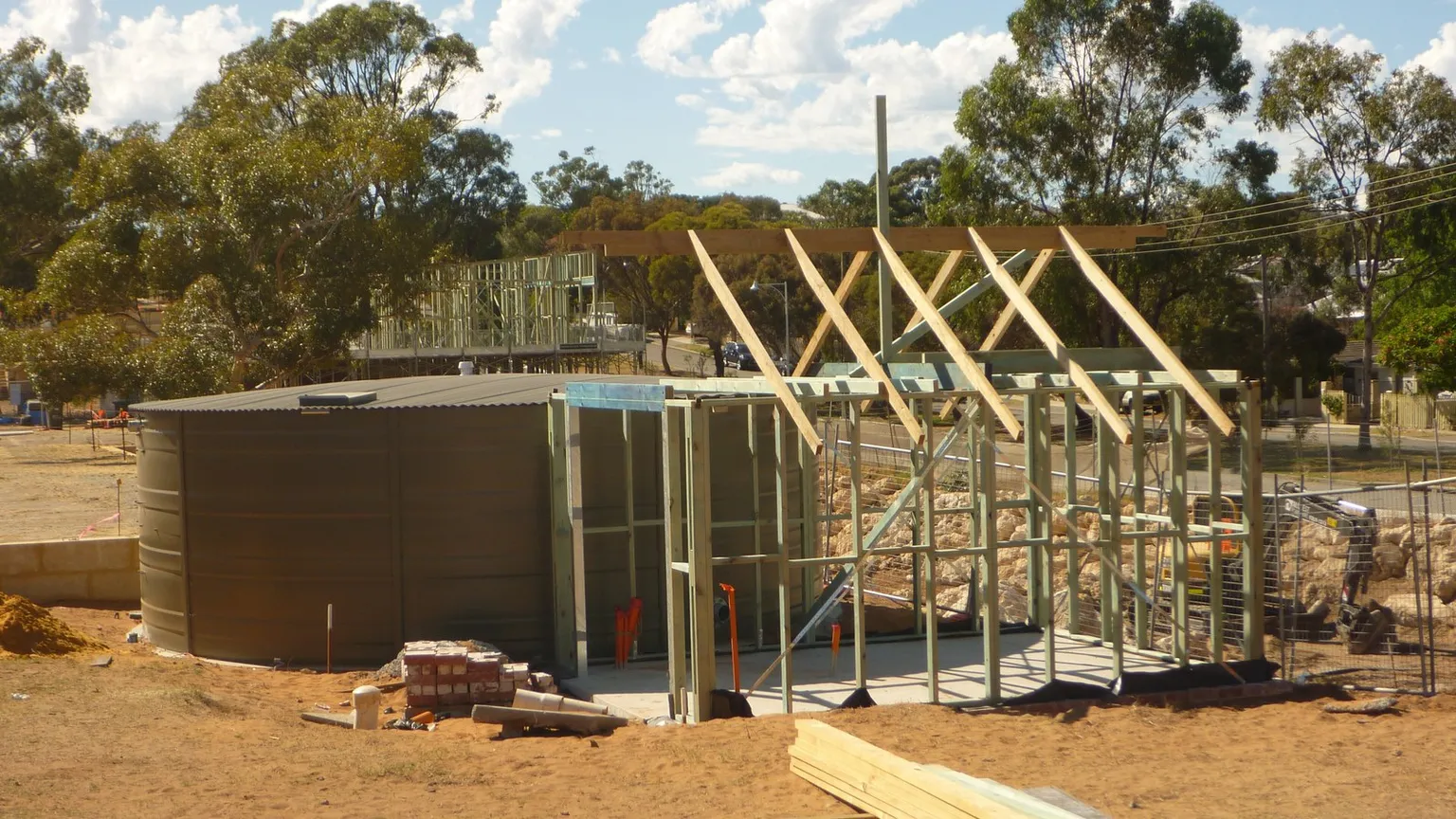
Photo: 'Pump house under construction in WGV development' by Sam Wilson, Wikimedia Commons, CC BY-SA 4.0.
Loading comments…