
Of all the conditions sitting on a development approval, the construction management plan is the one most often discovered too late. It is rarely the reason a project is refused, and it rarely appears in the feasibility. It simply arrives at the worst possible moment: the week the builder is ready to start.
A condition, not an application document
The mechanism is consistent, and once you see it, you stop missing it. Hornsby Shire Council explains that where it is deemed appropriate, the requirement for a construction management plan is generally applied as a condition on the notice of determination for a development approval, and that the plan must be lodged for assessment and approval before certain works begin. City of Gold Coast describes the same trigger: the need for a plan depends on the inclusion of a development condition in the City’s decision notice for a development approval, and the plan must be lodged before certain works begin.
So the requirement is not in the application you so carefully prepared. It is in the approval you skimmed because it said ‘approved’. That is the trap: a condition that blocks a start is easy to misread as an administrative afterthought.
What the plan is there to manage
Both councils describe the purpose the same way: managing the disruption that construction activity causes to the surrounding community. City of Gold Coast lists the content that typically belongs in one: security and public safety including pedestrian and cyclist safety around the site; a communication strategy with surrounding residents on matters such as changes to traffic flows, information signs and contractor contacts; construction traffic and parking management strategies; construction hours and construction staging; sediment and erosion control; refuse management; and protection of existing infrastructure services during works.
Hornsby Shire Council adds the traffic specifics: heavy vehicle routes, road closures, work zone permits and construction worker parking, plus information signs and contractor contact details, and environmental controls such as erosion and sediment control and tree protection.
Read that list as a scope definition for someone you have to engage. It is not a covering letter. It is traffic engineering, environmental controls and community communication, and each component has an owner.
The timing is the real risk
This is the part that belongs in your program. Woollahra Municipal Council is unusually frank about lead time: its guidance records that the process for approval of a construction traffic management plan can take up to 8 weeks.
Eight weeks is not an administrative inconvenience. It is two months of interest on the facility, two months of rates and insurance, and two months of a builder’s preliminary costs if the builder has been mobilised against a start date that cannot be met. Multiply that by the number of plans your conditions require — a construction management plan, a construction traffic management plan, a sediment and erosion control plan, sometimes a dust, acid sulfate soils or haulage plan — and the cumulative effect on a program is obvious.
Traffic management on the road is a separate, standardised discipline
Where a plan touches the public road, it stops being descriptive and becomes technical. Woollahra Municipal Council requires traffic guidance schemes prepared by an accredited SafeWork NSW control work training card holder for temporary changes such as road closures, temporary traffic routes, loss of pedestrian or cyclist access, and reversing manoeuvres onto a public road. Its checklist also requires swept-path drawings on a scaled plan showing the design vehicles can access and egress the site in a forward direction.
In New South Wales the baseline is a Transport for NSW standard. Transport published Technical Standard TS 05492:1.0 Traffic Control at Work Sites on 25 June 2026, which specifies the minimum technical requirements and provides comprehensive guidance for temporary traffic management on all public roads in NSW, and compliance with it is also a requirement for the use of portable traffic control lights and road work speed limit signs as a condition of the instrument of authorisation and delegation issued to councils.
Two practical consequences. First, the person preparing your traffic material needs the current qualification, not a generic traffic background. Second, your plan needs to be written against the standard that is current at the time, so a plan template reused from an older project may not satisfy the assessment.
What the assessment cannot do — and why that protects you
Both councils set out the limits of a plan assessment, and the limits are worth knowing because they keep the process proportionate. Hornsby Shire Council records that the assessment of a plan cannot eliminate all construction impacts, stop or change the construction of the development, regulate potential structural impacts on surrounding buildings, limit the lawful parking of construction worker vehicles on street, or restrict hours of work beyond what is permitted under the approved development consent.
City of Gold Coast states that it undertakes the assessment under the Planning Act 2016, the Local Government Act 2009 and the Environmental Protection Act 1994, and that its assessment cannot restrict hours of work beyond what is permitted under the Environmental Protection Act 1994 — which it identifies as between 6:30am and 6:30pm Monday to Saturday excluding public holidays.
If you understand that the controls come from statute and from your consent, you can answer a neighbour’s complaint accurately instead of improvising, and you can brief your builder on what the plan can and cannot promise.
The common trap: an approval treated as a start date
The failure mode is simple and expensive. The development approval is issued with a condition requiring a construction management plan before commencement. The developer reads ‘approved’, fixes a demolition date with the contractor, and only then asks who is preparing the plan. The council needs to assess it, the traffic material needs a qualified preparer, and the builder is standing still.
The second version is subtler. The plan is prepared and approved, then the build changes — a different crane, a different spoil route, a longer excavation stage — and nobody checks whether the approved plan still describes the works. An approved plan that no longer matches the site is a compliance exposure, not a formality.
A pre-start checklist for conditions like this
- Read the approval and list every condition that must be satisfied before any work starts.
- For each one, record the document required, who prepares it, who approves it, and the expected lead time.
- Identify which approval each condition blocks: demolition, excavation, or building work.
- Engage the traffic specialist early enough for the lead time, and confirm the preparer holds the current qualification.
- Check whether the site fronts a classified road or a bus route, which may bring a road authority into the process.
- Confirm permitted working hours from the statute and the consent, and write them into the construction program.
- Re-check the approved plan whenever the staging, plant or access route changes.
- Record every approval date in the same register as your other conditions, so nothing is satisfied twice or forgotten once.
The feasibility test
Add the plan preparation cost and, more importantly, its lead time to the program before you fix a start date. Model the scenario where the plan approval takes the longest published period your council states, and see what that does to interest, rates, insurance, and any preliminary costs your builder is entitled to while mobilised. Then ask whether the deal still works. A project whose margin depends on a two-month approval arriving in two weeks is not a well-tested deal; it is a program with a hole in it.
What a student should do next
You are not expected to prepare these documents yourself. Your town planner or certifier owns the condition mapping: which condition must be satisfied before which approval, and what each one blocks — ask for that as a written list at the moment the approval is issued. A qualified traffic engineer or traffic management designer owns the traffic content, the design vehicle and the swept paths, and any traffic guidance schemes must be prepared by a person holding the current accredited work zone traffic management qualification required in that jurisdiction. Your builder or principal contractor owns the site management, safety and environmental content, and the relevant council and road authority confirm what they will accept. Brief each of them with the actual condition wording, and diarise the approvals before you diarise the start.
Sources and boundaries
Sources checked 6 October 2026. Jurisdiction and limits: This guide describes a consent-condition requirement that is written differently in every jurisdiction. The NSW examples are Hornsby Shire Council and Woollahra Municipal Council; the Queensland example is the City of Gold Coast; and the temporary traffic management reference is the Transport for NSW technical standard applying to NSW public roads. Fees, forms, assessment periods, work zone traffic management qualification requirements and permitted working hours all differ between councils and states, and the binding requirement on any project is the wording of that project's own approval conditions. Verify the current requirements with the relevant council or road authority and with your own contractor and advisers.
- Hornsby Shire Council — Construction Management Plans. Used for: States that a construction management plan describes the construction project and how construction activities will be carried out and is prepared by or on behalf of the applicant, that where deemed appropriate the requirement is generally applied as a condition on the notice of determination for a development approval and must be lodged for assessment and approval before certain works begin, lists what a plan can cover including construction traffic and parking management with heavy vehicle routes, road closures, work zone permits and construction worker parking, and records the limits of assessment — it cannot eliminate all construction impacts, stop or change the construction of the development, or restrict hours of work beyond what the approved development consent permits. (Checked 6 October 2026)
- Woollahra Municipal Council — Construction Traffic Management Plan (CTMP). Used for: States the objective of a construction traffic management plan, describes it as a self-contained document covering each stage of work, the vehicles used, the numbers of vehicles accessing the site, their sizes, types and routes, with plans showing recommended routes, site access and proposed works zones, records that the process for approval can take up to eight weeks, requires traffic guidance schemes prepared by an accredited SafeWork NSW control work training card holder for temporary changes such as road closures, temporary traffic routes, loss of pedestrian or cyclist access and reversing manoeuvres onto a public road, and requires swept-path drawings showing vehicles can access and egress the site in a forward direction. (Checked 6 October 2026)
- City of Gold Coast — Construction management plans. Used for: States that a construction management plan helps manage disruption to the local community caused by certain construction activities, that the need for one depends on a condition in the City's decision notice for a development approval and that it must be lodged for assessment and approval before certain works begin, lists what plans can cover including security and public safety, communication with residents, construction traffic and parking, construction hours and staging, sediment and erosion control, refuse management and protection of infrastructure services, records that assessment is undertaken under the Planning Act 2016, the Local Government Act 2009 and the Environmental Protection Act 1994, and records the hours limits under the Environmental Protection Act 1994 as between 6:30am and 6:30pm Monday to Saturday excluding public holidays. (Checked 6 October 2026)
- Transport for NSW — Traffic Control at Work Sites Standard. Used for: Records that Transport for NSW published Technical Standard TS 05492:1.0 Traffic Control at Work Sites (TCAWS) on 25 June 2026, that the standard specifies the minimum technical requirements and provides comprehensive guidance for temporary traffic management on all public roads in NSW, that temporary traffic management comprises organising, arranging, guiding and controlling stationary and moving traffic including pedestrians, cyclists and all types of vehicles around a hazard or work site, and that compliance with the standard is also a requirement for the use of portable traffic control lights and road work speed limit signs as a condition of the instrument of authorisation and delegation issued to councils. (Checked 6 October 2026)
This article is general education, not personalised planning, legal, financial, tax or building advice. Requirements and outcomes vary by jurisdiction, site, contract, structure and circumstances. Check current information with the relevant authority and appropriately qualified advisers.
 Learn with Jason & AmyBuild practical small-scale property development skills with experienced mentors.Enquire now
Rate this article
Guest rating: select 1 star for poor or 5 stars for great. No account is required.
Leave a comment
Join the discussion. Your email address will not be published.
Frequently asked questions
Is a construction management plan part of my development application or a condition on it?
Usually a condition. Hornsby Shire Council states that where it is deemed appropriate, the requirement is generally applied as a condition on the notice of determination for a development approval, and that the plan must be lodged for assessment and approval before certain works begin. City of Gold Coast states the same mechanism: the need for a plan depends on the inclusion of a development condition in the City's decision notice, and the plan must be lodged for assessment and approval before certain works begin. That is exactly why it is so easy to miss — it is not in the application, it is in the approval.
How long does approval of a construction management plan take?
It varies, and the variation is the point. Woollahra Municipal Council records that the process for approval of a construction traffic management plan can take up to eight weeks. Council assessment periods are not standardised across councils or states, so the safe approach is to read your approval conditions on day one, identify every plan that has to be approved before a start, and build each one into the program with its own lead time. An eight-week approval discovered in the week you wanted to start is an eight-week delay with a full holding cost attached.
What does a construction management plan normally cover?
City of Gold Coast lists the common content: security and public safety including pedestrian and cyclist safety, a communication strategy with surrounding residents on matters such as changes to traffic flows and contractor contacts, construction traffic and parking management strategies, construction hours and staging, sediment and erosion control, refuse management, and protection of existing infrastructure services during works. Hornsby Shire Council lists similar categories including construction traffic and parking management with heavy vehicle routes, road closures, work zone permits and construction worker parking. Your own approval conditions will narrow that list to what council actually wants.
Can council restrict my working hours through the plan, or stop my construction?
No — and knowing the limits helps you keep the process in proportion. Hornsby Shire Council records that the assessment of a plan cannot eliminate all construction impacts, stop or change the construction of the development, regulate potential structural impacts on surrounding buildings, limit the lawful parking of construction worker vehicles on street, or restrict hours of work beyond what is permitted under the approved development consent. City of Gold Coast states its assessment is undertaken under the Planning Act 2016, the Local Government Act 2009 and the Environmental Protection Act 1994, and that it cannot restrict hours beyond those permitted under the Environmental Protection Act 1994 — which it identifies as between 6:30am and 6:30pm Monday to Saturday excluding public holidays. The controls come from statute and consent, not from council preference.
What is the relationship between the plan and traffic control on the road?
They are related but not identical. Woollahra Municipal Council requires traffic guidance schemes prepared by an accredited SafeWork NSW control work training card holder for temporary changes such as road closures, temporary traffic routes, loss of pedestrian or cyclist access, or reversing manoeuvres onto a public road. In New South Wales the technical baseline is Transport for NSW's standard: Transport published Technical Standard TS 05492:1.0 Traffic Control at Work Sites on 25 June 2026, and it specifies the minimum technical requirements and comprehensive guidance for temporary traffic management on all public roads in NSW, including the use of portable traffic control lights and road work speed limit signs as a condition of the instrument of authorisation and delegation issued to councils. So the plan needs to reference the current standard, and the people preparing the schemes need the current qualification.
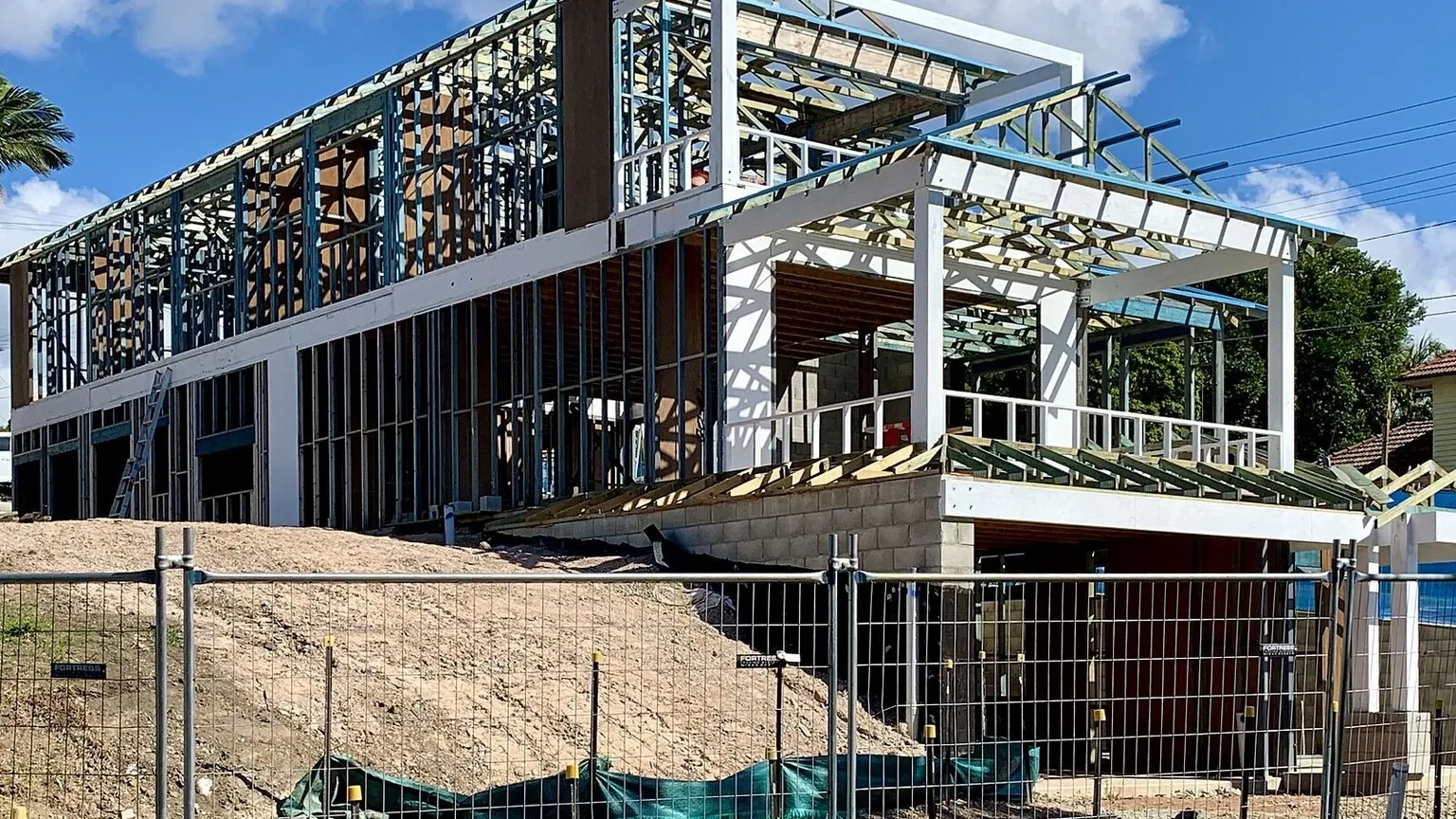
Photo: 'House under construction in Manly, Queensland, 2020' by Kgbo, Wikimedia Commons, CC BY-SA 4.0.
Loading comments…