
A pool is an asset with a legal attachment. In New South Wales that attachment survives your settlement, your subdivision and your plan registration, and it can be sold to a buyer as a defect rather than a feature. If you are buying a site with an existing pool, or keeping the pool house while you subdivide the rear, the compliance position belongs in your feasibility alongside the survey and the planning certificate.
Here is the practical version. NSW requires pools to be registered and barriers to comply, and the sale and lease of a property with a pool carries prescribed documents. Get the sequence wrong and the risk lands on your contract, not just your fence.
The deal question: does the pool transfer with the lot, and is it compliant?
Start with what a certificate of compliance actually is. Griffith City Council's application form reproduces section 22D of the Swimming Pools Act 1992. Under it, the requirements for the issue of a certificate are that the swimming pool is registered under Part 3A and that the pool complies with the requirements of the Part. A local authority or registered certifier must issue the certificate if it has inspected the pool and is satisfied those requirements are met, and the section states that a certificate of compliance remains valid for a period of 3 years from the date on which it is issued.
The same reproduction records a timing point your program should absorb: for appeal purposes, the council is taken to have refused the application if it has not finally determined it within six weeks. Six weeks is a long time to discover you needed a certificate, and it is exactly the kind of item that sits quietly until settlement week.
What the sale and lease rules require
Penrith City Council's information sheet for sellers explains that from 29 April 2016 new laws apply to the sale and lease of properties with a swimming pool in NSW. If you are selling a property with a pool, your contract for the sale of land must have one of the following attached: a certificate of compliance, or a relevant occupation certificate and a certificate of registration, or a certificate of non-compliance.
The operational detail matters. The same sheet records that a certificate of compliance or relevant occupation certificate is valid for three years from the date of issue, and that a buyer who receives a certificate of non-compliance then has 90 days from settlement to remedy identified defects and bring the barrier into compliance. It also notes the exemption: these laws do not apply to properties with more than two lots and a shared pool, such as units in strata complexes or community schemes.
Clarence Valley Council's pool safety page describes the same framework from the buyer's side and adds the older-barrier issue that catches renovation and subdivision projects: since 2010, any new pool where the boundary fence forms part of the pool safety barrier requires a 1800 mm high boundary fence with a 900 mm non-climb zone on the pool side. It also records that NSW Fair Trading has recently extended that requirement to apply to all pools that are the subject of an application for a Swimming Pool Compliance Certificate, regardless of the age of the pool.
Read that last sentence against your subdivision plan. If the existing side fence is part of the pool barrier, upgrading it is not optional decoration.
The checks a student would run, in order
- Establish whether the pool is registered and, if so, what certificate history is attached to it.
- Have the barrier inspected and photographed before you exchange, not after.
- Ask the council or certifier to confirm what would be required to obtain a certificate of compliance, including any boundary fence change.
- Check the contract for sale's prescribed documents and the certificate's issue date against your settlement program.
- If you are subdividing, ask your lawyer how the certificate attaches to the new lot once the plan is registered.
- Price the barrier works in your feasibility, and keep the dividing-fence clause in mind - extra expenses for enclosing a pool fall on the owner of the property containing the pool.
The trap
Treating the pool as an existing-improvement asset that transfers without condition, and treating the 90-day remedy period as somebody else's problem. On the buy side, a certificate of non-compliance is a known quantity: it tells you what is wrong and gives you a deadline, and the State Library's summary of the Dividing Fences Act confirms that the pool-owner pays the extra enclosure expenses in a fencing work context. On the sell side, discovering a compliance problem in the week before auction compresses your options exactly when you have the least room.
What it means for feasibility
Carry the pool as three numbers: the inspection and certificate cost, the barrier rectification range, and a program allowance for the inspection and any re-inspection. Then decide the strategy deliberately - rectify early and sell the property as compliant, or sell with a certificate of non-compliance and price the obligation into the buyer's expectation. Either can work. Drifting into one of them by accident rarely does.
You are not expected to solve this yourself. The correct next step is to brief a property lawyer acting on the conveyance or the subdivision, with a registered certifier or the council's pool inspection service confirming the barrier, and ask them to confirm the registration status, what the contract requires, and how the certificate travels with the new lot. They do the assessment. You make the timing call with the deadline in front of you.
Sources and boundaries
Sources checked 2 October 2026. Jurisdiction and limits: The Swimming Pools Act 1992 (NSW) provisions reproduced in Griffith City Council's certificate of compliance application form, the 2016 sale and lease requirements described in Penrith City Council's information for sellers and Clarence Valley Council's pool safety page, and the NSW Swimming Pools Register operated by the State. Pool safety law in other states and territories, current council fees, and the condition of any specific pool barrier are outside this article.
- Griffith City Council — Application for certificate of compliance for swimming pool (SD-FO-237). Used for: Reproduces section 22D of the Swimming Pools Act 1992: the pool must be registered under Part 3A and comply with the Part, a certificate of compliance remains valid for 3 years, and the council is taken to have refused the application if it has not determined it within six weeks (retrieved through the browser; the server returns 403 to plain curl) (Checked 2 October 2026)
- Penrith City Council — New laws for selling a property with a swimming pool in NSW. Used for: The 29 April 2016 contract requirements, the three-year validity of a certificate of compliance or relevant occupation certificate, the 90 days from settlement for a buyer to remedy defects, and the exemption for strata or community schemes with more than two lots (Checked 2 October 2026)
- Clarence Valley Council — Swimming Pool Safety and Requirements. Used for: The selling, leasing and buying obligations, the three-year validity of a certificate of compliance, the 90-day obligation on a buyer receiving a certificate of non-compliance, and the 1800 mm boundary fence requirement for new pools where the boundary fence forms part of the barrier (Checked 2 October 2026)
- Dividing Fences Act 1991 — pool enclosure costs (State Library of NSW summary). Used for: That where fencing work includes special requirements for enclosing a swimming pool under the Swimming Pools Act 1992, the extra expenses must be met by the owner of the property that contains the pool (Checked 2 October 2026)
This article is general education, not personalised planning, legal, financial, tax or building advice. Requirements and outcomes vary by jurisdiction, site, contract, structure and circumstances. Check current information with the relevant authority and appropriately qualified advisers.
 Learn with Jason & AmyBuild practical small-scale property development skills with experienced mentors.Enquire now
Rate this article
Guest rating: select 1 star for poor or 5 stars for great. No account is required.
Leave a comment
Join the discussion. Your email address will not be published.
Frequently asked questions
What documents must be attached to a contract when selling a property with a pool in NSW?
Penrith City Council's information for sellers states that if you are selling a property with a pool, your contract for the sale of land must have one of the following attached: a certificate of compliance, or a relevant occupation certificate and a certificate of registration, or a certificate of non-compliance. The sheet adds that failure to attach one of these may render the contract incomplete and enable the buyer to rescind.
How long is a certificate of compliance valid?
Griffith City Council's reproduction of section 22D of the Swimming Pools Act 1992 states that a certificate of compliance remains valid for a period of 3 years from the date on which it is issued, and that it ceases to be valid if a direction is issued under section 23. Penrith City Council's sheet records the same three-year period.
What happens if the pool is non-compliant?
Penrith City Council's sheet records that a buyer then has 90 days from the date of settlement to remedy any identified defects and bring the pool barrier into compliance. Clarence Valley Council's page puts the same 90-day obligation on a buyer who receives a certificate of non-compliance. Confirm the current position on your specific contract with your lawyer.
Does a shared pool in a strata scheme follow the same rules?
No. Penrith City Council's sheet states that these laws do not apply to properties with more than two lots and a shared pool, such as units in strata complexes or community schemes. If your project involves a shared pool in a strata or community scheme, ask your lawyer which regime applies.
The boundary fence forms part of my pool barrier. What standard applies?
Clarence Valley Council's pool safety page states that since 2010 any new pool where the boundary fence forms part of the pool safety barrier requires a 1800 mm high boundary fence with a 900 mm non-climb zone on the pool side of the fence, and that NSW Fair Trading has extended this to all pools that are the subject of an application for a Swimming Pool Compliance Certificate regardless of age. Confirm the current requirement with your certifier or council for the specific barrier.
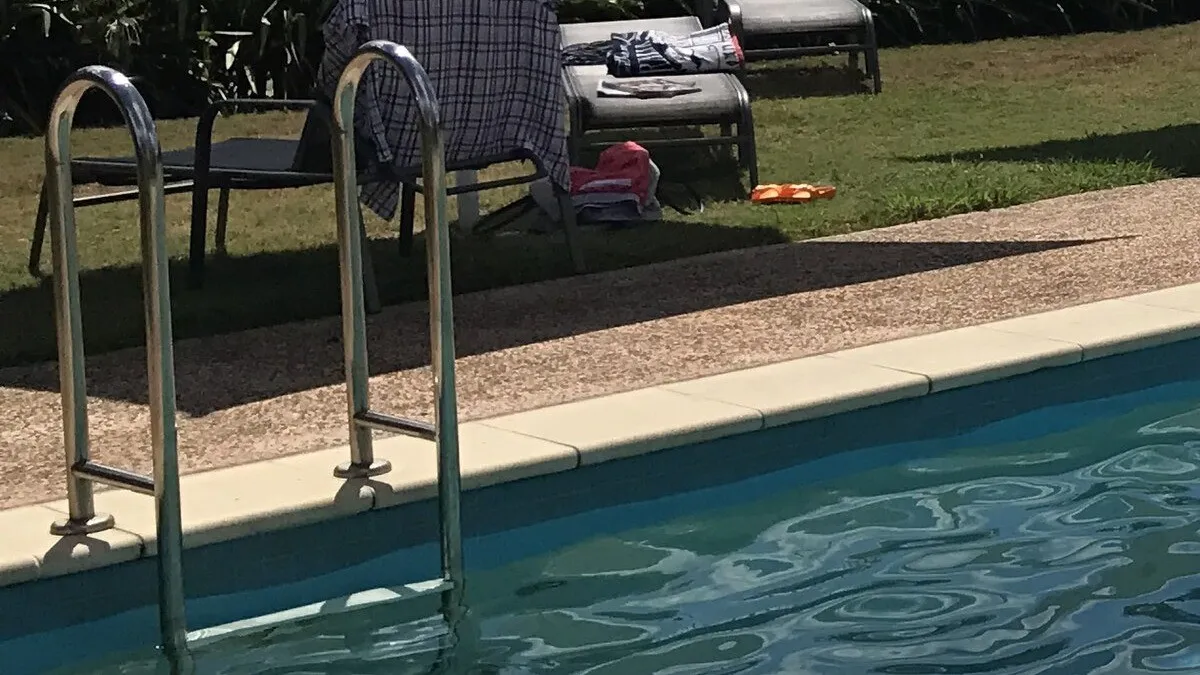
Photo: Kgbo, CC BY-SA 4.0, via Wikimedia Commons.
Loading comments…