
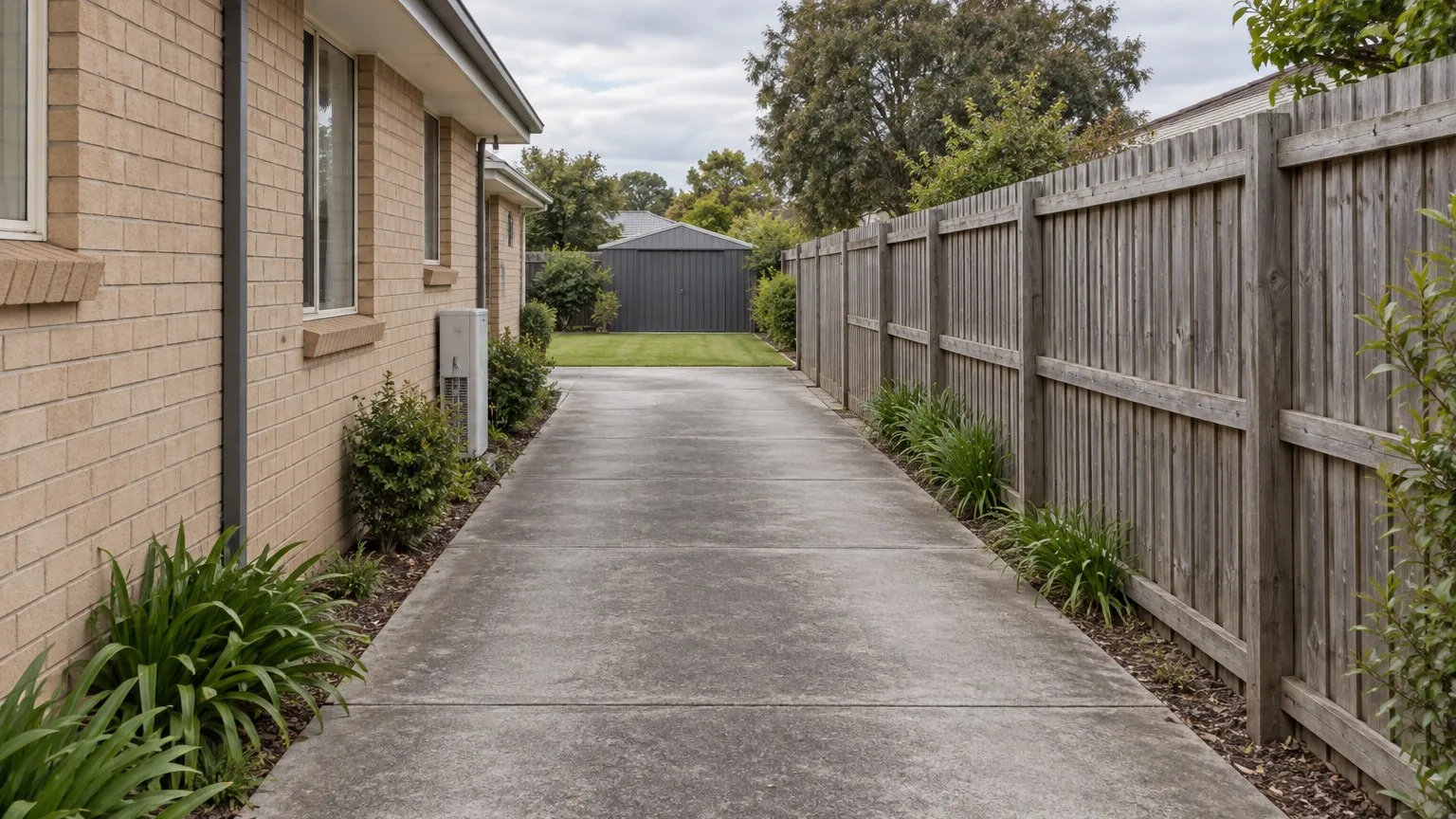
You have found a block with a wide frontage, a tired house at the front and room at the back. The maths looks simple: keep the house, put a second dwelling behind it, sell the rear lot. Then your surveyor draws a narrow strip of driveway down the side and you realise that strip is doing more work than any other part of the site.
That strip is the access handle, and on a battle-axe subdivision it is usually the constraint that decides whether the deal works. Developers spend hours on floor plans and almost none on the handle. It is the wrong way around.
The deal question: can a second dwelling actually reach the street?
A battle-axe lot is a lot behind another lot, connected to the street by an access handle. The idea is sound. It lets you create a second lot on a property that has only one street frontage, which is exactly the situation on most older suburban blocks.
The question that decides the deal is not whether the rear yard is big enough. It is whether the handle that serves that rear lot is wide enough, long enough, permitted to serve that many lots, and capable of carrying the driveway, the drainage and the landscaping the council will demand inside it.
The checks a student would run, in order
The sequence matters, because each check either kills the idea or narrows the next one.
- Read the council's access handle control first, before the survey. These are published numbers, and they differ remarkably between councils. Camden Council's DCP 2019 Part 3 requires a battle-axe access handle to be at least 3.5 metres wide if it services one additional lot and at least 5 metres if it services two lots. Wollondilly Shire Council's DCP 2016 Volume 3 publishes 5 metres with a 3 metre minimum pavement width for a residential handle serving one allotment, and 6 metres with a 4 metre pavement for two or three allotments. Two councils, two very different answers. A handle that works in one local government area fails in the next.
- Count how many lots the handle must serve. This is where a good idea gets quietly capped. Camden states a handle may not service more than two lots, and requires reciprocal rights of way. Wollondilly states that servicing more than three allotments in the R1, R2 or R3 residential zones is not permitted. If your plan needs a third or fourth rear lot off one handle, the answer is often no, and it is no before you have paid for anything.
- Check whether the handle area counts towards minimum lot size. Frequently it does not. Camden's DCP states a battle-axe lot should be considered only where it has a minimum lot area of 600 square metres excluding the access handle. The handle has to exist and be built, but it does not help the rear lot meet its area control. On a tight site, that single sentence can reduce your yield.
- Measure the handle length. Camden caps a battle-axe access handle at a maximum length of 50 metres. A long, narrow site with a deep rear yard and a house sitting far forward can put the rear building envelope well beyond that limit, even though the block is large enough on paper.
- Work out what else has to fit in the handle. The pavement is the obvious item. Wollondilly also requires landscaping between the edge of the driveway pavement and the property boundary, with a minimum width of one metre at all points. Camden requires a 3m x 3m splay in accordance with its battle-axe figure. Stormwater, sewer and other services often have to run in or beneath the same strip. A handle drawn at the minimum width with no allowance for any of this is a drawing that will not be built as drawn.
- Check the title mechanics for a shared handle. Where a handle serves more than one allotment, Wollondilly requires that the handle form part of each of the allotments it serves, with reciprocal rights of carriageway provided. That is a registered dealing, not an understanding between two owners. It needs to be documented and it has a legal cost attached.
- Confirm what you can build on the rear lot. Battle-axe lots attract extra controls. Camden's DCP states that a dual occupancy must not be located on a battle-axe lot, so the strategy of a battle-axe lot carrying its own duplex is closed. A building envelope has to be demonstrated for solar access, private open space, setbacks and site coverage, and it must be far enough from existing and proposed dwellings to protect privacy.
Why this order, and not the other way around
Developers usually start with the yield — how many dwellings can I fit — and then ask an engineer to make the access work. That is the expensive order.
Handle controls first, because they tell you whether the second lot can exist at all. Servicing limits second, because they cap the number of lots regardless of how much land you have. Excluding the handle from lot area third, because it changes the arithmetic. Length fourth, because it tests whether the rear envelope is reachable. Contents of the handle fifth, because landscaping, splay and services all compete for the same few square metres. Title mechanics sixth, because rights of carriageway outlive the project. What you can build on the rear lot last, because that is where you decide the product.
Run it in that order and each answer narrows the next question. Run it backwards and you will be redesigning at documentation stage, which is the most expensive time to redraw a subdivision.
The trap: designing the house and hoping the handle fits
The emotional trap on battle-axe subdivisions is that the rear yard looks generous. You stand at the back fence, look at the space and start planning a dwelling. The handle is a thin strip you barely notice.
Take an illustrative southern Sydney block with a 15 metre frontage and a house set 11 metres back. A 3.5 metre handle down one side looks workable. Now add the one metre landscaping strip the council requires between the driveway pavement and the boundary, the 3m x 3m splay at the street, the stormwater line that has to reach the rear lot, and the clearance the dwelling on the front lot needs from the handle. Suddenly the buildable width of the rear envelope has narrowed by several metres, and the dwelling that fitted comfortably on the sketch may not fit the resulting envelope.
None of that is visible from the back fence. All of it is visible from the council's published controls and a survey plan.
Cost, timing and feasibility implications
- Yield. A handle that cannot service a third lot, or a handle area excluded from the minimum lot size, reduces the number of lots you can create. That flows straight into revenue.
- Civil cost. A wider handle with a sealed pavement, a splay, drainage and landscaping costs more than a narrow strip of gravel. Where the council's engineering specification applies, the pavement has to be built to that standard, not to your own.
- Title cost. Reciprocal rights of carriageway and any easements over a shared handle need to be prepared and registered. Add solicitor and registration costs to the feasibility, and expect the arrangement to be a feature your buyer will read in the contract.
- Program. Survey, civil design and the creation of the title documents all sit on the critical path to a subdivision certificate. Discovering a handle problem late pushes everything after it.
- Offer price. If the handle limits the site to one additional lot rather than two, the residual land value falls. That is not a reason to walk away — it is a reason to re-price before you exchange.
The Think Property Club lesson
The access handle teaches a habit that is worth more than any single control: ask the constraint to show you its boundary before you fall in love with the layout. Handle width, handle length, how many lots it may serve and whether its area is excluded from lot size are all answerable questions, and all of them are answered from published documents and a survey rather than from opinion.
That is the discipline students practise — a repeatable check on a specific site, in a specific council area, before money moves. The developers who get battle-axe subdivisions right are not the ones with the best sketches. They are the ones who tested the handle first.
Your next actions before you make an offer
- Download the current subdivision and residential development controls for the specific council area.
- Write down the handle width, minimum pavement width, maximum length, splay and landscaping requirements, and the maximum number of lots a handle may serve.
- Order a survey showing the existing dwelling, boundaries and any existing services.
- Check whether the access handle area is excluded from the minimum lot size calculation.
- Confirm whether a dual occupancy or secondary dwelling is permitted on the proposed rear lot.
- Ask a civil engineer to sketch the handle with pavement, drainage and landscaping inside it.
- Ask your solicitor about the rights of carriageway and any easements needed on title.
- Re-run the feasibility with the handle constraints in place, then decide your offer ceiling.
Reader question: if the council excluded your access handle area from the lot size calculation, does your second lot still exist?
Sources and boundaries
Sources checked 24 September 2026. Jurisdiction and limits: Australian general information with New South Wales and Western Australian examples. The specific controls described are those published by Camden Council (Development Control Plan 2019, Part 3), Wollondilly Shire Council (Development Control Plan 2016, Volume 3) and the City of Swan, Western Australia, as retrieved at the checked date. Access handle widths, minimum lot areas excluding the handle, maximum handle lengths, servicing limits, splay requirements, landscaping requirements and rights of carriageway differ substantially between councils and are amended from time to time. Any figure in this article is an example of one council's published control, not a general rule for Australia or even for New South Wales. Confirm the current controls for the specific site with the relevant council and take title advice from a qualified solicitor.
- Camden Council — Development Control Plan 2019, Part 3 Residential Subdivision Controls (Battle-axe Lots). Used for: the minimum battle-axe lot area excluding the access handle, the minimum access handle widths for one and two lots, the maximum handle length, the splay requirement, the reciprocal rights of way requirement and the prohibition on dual occupancy on a battle-axe lot (Checked 24 September 2026)
- Wollondilly Shire Council — Development Control Plan 2016, Volume 3 Subdivision of Land (access handle controls). Used for: the published access handle minimum widths and minimum pavement widths by zone and by number of allotments served, the prohibition on servicing more than three allotments in residential zones, the reciprocal rights of carriageway requirement for shared handles, the one metre landscaping strip and the rule against two access handles along the same property boundary (Checked 24 September 2026)
- City of Swan (WA) — Battleaxe Subdivision Requirements. Used for: the urban and rural minimum battleaxe leg widths for single and shared access and the minimum sealed pavement standards that apply to the leg (Checked 24 September 2026)
This article is general education, not personalised planning, legal, financial, tax, privacy, safety or building advice. Requirements and outcomes vary by jurisdiction, site, contract, structure and circumstances. Check current information with the relevant authority and appropriately qualified advisers.
 Learn with Jason & AmyBuild practical small-scale property development skills with experienced mentors.Enquire now
Rate this article
Guest rating: select 1 star for poor or 5 stars for great. No account is required.
Leave a comment
Join the discussion. Your email address will not be published.
Frequently asked questions
How wide does a battle-axe access handle need to be?
It depends on the council and on how many allotments the handle serves, and the published numbers genuinely differ. Camden Council's DCP 2019 requires a battle-axe access handle to be at least 3.5 metres wide if it services one additional lot and at least 5 metres wide if it services two lots. Wollondilly Shire Council publishes 5 metres (with a 3 metre minimum pavement width) for a residential handle serving one allotment and 6 metres (with a 4 metre pavement) for two or three allotments. Never assume a 3 metre handle is enough — check the current control for the specific council area before you commit to a survey.
Can more than one lot share an access handle?
Sometimes, but the limit is set locally and it is deliberately tight. Camden allows a handle to service no more than two lots and requires reciprocal rights of way. Wollondilly permits two or three allotments on a residential handle but states that servicing more than three allotments in the R1, R2 or R3 zones is not permitted. Where a handle is shared, the handle must form part of each allotment it serves with reciprocal rights of carriageway provided. That is a title document, not a verbal arrangement between neighbours, and it needs to be prepared properly.
Does the access handle count towards my minimum lot size?
Often it does not, and getting this wrong destroys the yield you thought you had. Camden Council's DCP states a battle-axe lot should be considered only where it has a minimum lot area of 600 square metres excluding the access handle. The handle still has to be created and still has to be built, but it does not help you meet the lot area control. On a site where the arithmetic was already marginal, excluding the handle can be the difference between a two-lot subdivision and a one-lot outcome.
What else has to be inside the access handle?
More than most buyers expect. The handle must carry the driveway pavement, and Wollondilly requires landscaping between the edge of the driveway pavement and the property boundary with a minimum width of one metre at all points, plus a 3m x 3m splay at the street under Camden's controls. Services and stormwater usually have to fit in or under the handle as well, and the council's engineering design and construction specifications apply to what is built there. A handle drawn at the bare minimum width often has no room left for the landscaping or the drainage the council will require.
Is a battle-axe lot a good strategy for a small site?
It can be, but only after you have tested the handle properly. A battle-axe lot is often the only way to get a rear dwelling onto a block with a single street frontage, and that can add real value. The traps are the excluded handle area, the handle width and length limits, the servicing limit on shared handles and the fact that a dual occupancy is not permitted on a battle-axe lot under Camden's controls. Test the handle first, price the pavement and landscaping, and confirm the title documents with your solicitor before you make an offer.
Loading comments…