
A conditional subdivision approval in Western Australia looks like the hard part is over. It is not. The approval is an outline approval with conditions attached, and the titles do not exist until each condition has been cleared by the authority named in it and the plan of survey has been endorsed. The clearance chain, not the application, is what converts an approval into a saleable lot — and it is where holding costs quietly accumulate.
What a clearance actually is
The Commission's own model conditions describe it precisely. Under the Model Subdivision Conditions Schedule (December 2025), the landowner/applicant is responsible for obtaining all 'clearances', which is the advice of the public authorities specified in the conditions confirming that the requirements of the subdivision conditions have been fulfilled.
Two structural points follow from that. First, the clearance is the advice of the authority named in the condition, not your own statement that the work is done. Second, the onus is on you: the same schedule states that the Commission does not use a prescribed formula and that the landowner and/or applicant is responsible for demonstrating, with convincing evidence, that the application should be approved.
And there is a backstop. The schedule states that it is usual practice for subdivision conditions to be drafted to include a clearance agency, and that when no clearance agency is nominated the Commission is the clearing agency. It also states that all subdivision conditions are to the Commission's satisfaction, so the Commission will arbitrate if there is a dispute between the clearance agency and the applicant as to the clearance requirements. Read every condition and identify who clears it before you commit to a programme.
Why the Commission checks conditions that other approvals do not
There is a real difference between a development approval and a subdivision approval, and the model schedule says so: the Commission actively checks all subdivision conditions as part of the second, endorsement phase, which is different from development approvals where development conditions may not be monitored for compliance unless there is a particular reason to do so, such as a public complaint.
That is the reason the clearance chain has teeth. The plan will not be endorsed until the conditions are cleared, and the lots cannot be titled until the plan is endorsed.
The clock, and the extension that is hard to get
Approval currency is set by statute. The Commission's Guide to Subdivision Applications and Fees records that subdivision approval is valid for three years for subdivisions of five lots and less, and four years for subdivisions of six lots and more (s 145 Planning and Development Act 2005), and that the applicant must apply for Commission endorsement before approval expires before registration of title can proceed.
There is a separate extension path, and it is not generous. The Commission's current subdivision forms and application pages state that under section 145A it may grant an extension of 2 years to the period for submission of a diagram or plan of survey, and that for an extension to be granted the Commission must be satisfied the criteria in section 145A(4) are met — which may be difficult to achieve if the Form 4A application is submitted when there is more than 6 months remaining on a 3-year approval (5 lots or less), or more than 12 months remaining on a 4-year approval. In other words, you must be able to demonstrate real progress, and lodging early works against you.
Note the tension between those two documents and treat it as a live question rather than a settled rule: the 2023 guide describes the currency period and states that the legislation does not allow an extension of that time, while the current forms page describes a section 145A extension of the plan-submission period. Confirm the current position with the Commission or your surveyor on the date you are relying on it.
The clearance chain in practice
Landgate's plan approval requirements describe the mechanics: a release letter is lodged with Landgate before the plan is released to the Commission, and once the subdivision is cleared by the relevant authorities, the clearances are lodged with WAPC and a request made to Landgate to release the Plans to WAPC. Where all clearances are held, the Commission checks the conditions have been met and then stamps and signs the plan — a step Landgate then measured in days, not months.
So the endorsement itself is quick. What is not quick is the front end: the surveys, the servicing design, the earthworks, the drainage, the local government clearances, and any agency that will not clear until it has inspected. Conditions can also be staged: the model schedule recognises sections 145(3) and 145(6) on staged applications and section 145(4A), under which an applicant may not need to fulfil every condition at the same time but rather only those relevant to that stage. It also warns that the Commission is cautious about staging used for nesting.
A practical acquisition test
- Ask the planner to list every condition, the clearance agency named in it, and the evidence that agency will require.
- Identify which conditions require physical works and which are documentary, and sequence them.
- Get the surveyor to price the survey, plan lodgement and clearance management separately from the planning work.
- Put the approval expiry date in your programme, with the endorsement date and a buffer in front of it.
- Confirm what the local government will and will not clear, and how long it takes in that municipality.
- Model the holding cost of the clearance period, not just the cost of the fees.
The common trap
The trap is treating the approval as the milestone. A feasibility that stops at "approval" and then assumes titles in a few weeks will understate interest, rates, insurance and site holding costs. The second trap is discovering late that a service authority, not the Commission, controls a critical clearance, and that its inspection queue sets your date. The third is confusing the approval period with the plan-submission period, which is exactly the ambiguity the 2023 guide and the current forms page leave open.
What a capable student does next
You are not expected to run the clearance process. Brief a licensed surveyor to manage the plan and the clearances, and a town planner to read the conditions and confirm who clears each one and in what order. Ask a civil engineer about the servicing, drainage and earthworks conditions. The specialists do the technical assessment and lodge the documents, and they confirm the site-specific answer with the Commission and each clearing authority. Your job is to hold the clearance schedule, the dates and the holding-cost model.
Sources and boundaries
Sources checked 7 October 2026. Jurisdiction and limits: Western Australia only. All controls quoted are WA controls read from WA Government sources on 7 October 2026. Conditions are cleared by the particular authority named in each condition, and the Commission's own documents should be re-read for the current position on approval currency and extensions. Other states and territories run different subdivision and plan registration processes.
- Western Australian Planning Commission — Model Subdivision Conditions Schedule (December 2025, PDF). Used for: States that the landowner or applicant is responsible for obtaining all clearances, which are the advice of the public authorities specified in the conditions confirming that the requirements of the subdivision conditions have been fulfilled; that advice from public authorities is important in giving the Commission confidence that the requirements of the condition have been fulfilled so the Commission can endorse the diagram or plan of survey of subdivision; that it is usual practice for subdivision conditions to be drafted to include a clearance agency and that when no clearance agency is nominated the Commission is the clearing agency; that all subdivision conditions are to the satisfaction of the Commission and the Commission will arbitrate a dispute between the clearance agency and the applicant as to the clearance requirements; that the Commission actively checks all subdivision conditions as part of the second, endorsement phase, unlike development approvals where conditions may not be monitored for compliance unless there is a particular reason; that the landowner or applicant is responsible for demonstrating with convincing evidence that the application should be approved; and that subdivision applications can be staged, with sections 145(3), 145(4A) and 145(6) of the Planning and Development Act 2005 recognised. (Checked 7 October 2026)
- Western Australian Planning Commission — Guide to Subdivision Applications and Fees (June 2023, PDF). Used for: Describes the subdivision application and assessment process: an application is referred to public bodies and private utilities, the Commission considers a report taking into account any region scheme or local planning scheme, relevant Commission policies, comments from referral agencies and the physical attributes or conditions of the site, and may approve with or without conditions or refuse; states that subdivision approval is valid for three years for subdivisions of five lots and less and four years for subdivisions of six lots and more under section 145 of the Planning and Development Act 2005, that the applicant must apply for Commission endorsement before approval expires before registration of title can proceed, and that a refusal or conditions may be reconsidered if a written request is lodged on the prescribed form within 28 days of the decision. (Checked 7 October 2026)
- Western Australian Planning Commission — Subdivision application forms, guidelines and checklists. Used for: Publishes the subdivision application forms, including the Form 1A application for approval of freehold, survey-strata or leasehold (survey-strata) subdivision, the Form 1C application for endorsement of a deposited plan or survey-strata plan, and the Form 4A application under section 145A to extend the period for submission of a diagram or plan of survey; and states that under section 145A the Commission may grant an extension of 2 years to the period for submission of a diagram or plan of survey, that the Commission must be satisfied the criteria in section 145A(4) are met, and that this may be difficult to achieve where more than 6 months remains on a 3-year approval (5 lots or less) or more than 12 months remains on a 4-year approval. (Checked 7 October 2026)
- Landgate — SPP-20 Plan Approval Requirements. Used for: Explains the plan processing sequence: a release letter must be lodged with Landgate before a plan is released to the Commission, the plan is delivered to the Commission on behalf of the surveyor, and once the subdivision is cleared by the relevant authorities the clearances are lodged with the Commission and a request made to Landgate to release the plans; and states that providing all clearances are held by the Commission on receipt of the plans, the Commission will check the conditions of subdivision have been met and then stamp and sign the original as approved, a procedure that then took three to five days. (Checked 7 October 2026)
This article is general education, not personalised planning, legal, financial, tax or building advice. Requirements and outcomes vary by jurisdiction, site, contract, structure and circumstances. Check current information with the relevant authority and appropriately qualified advisers.
 Learn with Jason & AmyBuild practical small-scale property development skills with experienced mentors.Enquire now
Rate this article
Guest rating: select 1 star for poor or 5 stars for great. No account is required.
Leave a comment
Join the discussion. Your email address will not be published.
Frequently asked questions
How long is a Western Australian subdivision approval valid?
The Commission's Guide to Subdivision Applications and Fees states that subdivision approval is valid for three years for subdivisions of five lots and less and four years for subdivisions of six lots and more under section 145 of the Planning and Development Act 2005. Confirm the current position for your approval, because a separate extension path for the plan-submission period is described on the Commission's current forms page.
Who clears the subdivision conditions?
The landowner or applicant is responsible for obtaining the clearances, which are the advice of the public authorities specified in the conditions confirming the requirements have been fulfilled. Where a condition nominates no clearance agency, the Commission is the clearing agency, and the Commission will arbitrate a dispute about clearance requirements.
Do the titles issue when the subdivision is approved?
No. The Commission endorses the diagram or plan of survey once the conditions are cleared, and Landgate's process describes the plan being released and delivered to the Commission, then checked and stamped once all clearances are held. The lot must be created and its title registered before it can be sold.
Can I clear the conditions in stages?
The model conditions schedule recognises staged subdivision applications under sections 145(3) and 145(6) of the Planning and Development Act 2005, and section 145(4A) allows that an applicant may not need to fulfil every condition at the same time but only those relevant to that stage. It also warns the Commission is cautious about staging used for nesting, so confirm your staging proposal in writing.
What if the approval is about to expire and the conditions are not cleared?
The Commission's forms page describes an application under section 145A for a 2-year extension of the period to submit a diagram or plan of survey, but states the Commission must be satisfied of the section 145A(4) criteria and that this may be difficult where more than 6 months remains on a 3-year approval or more than 12 months on a 4-year approval. Take advice from your surveyor early rather than late.
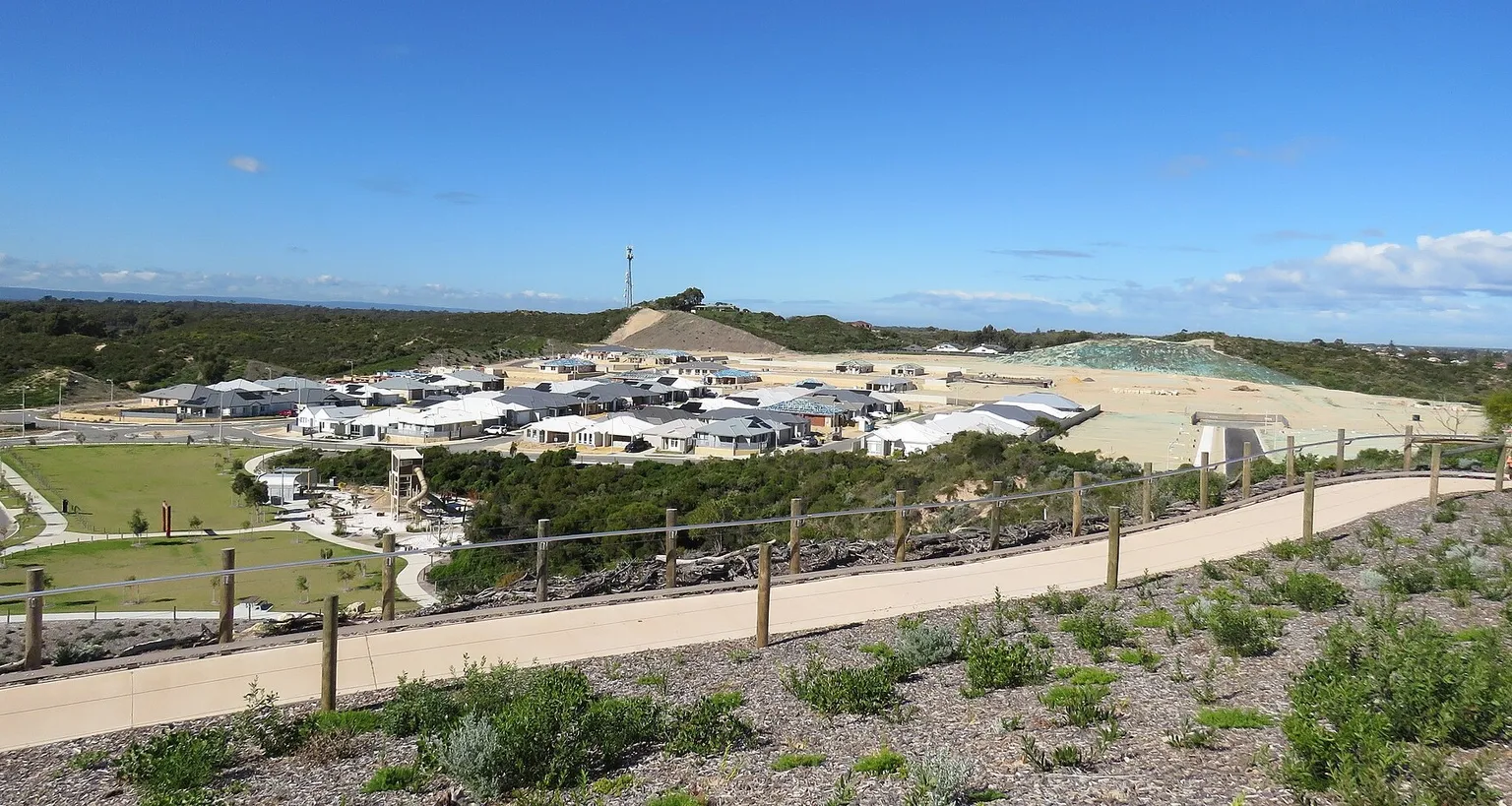
Photo: 'New housing estate in Golden Bay, Western Australia, August 2023 04' by Calistemon, Wikimedia Commons, CC BY-SA 4.0
Loading comments…