
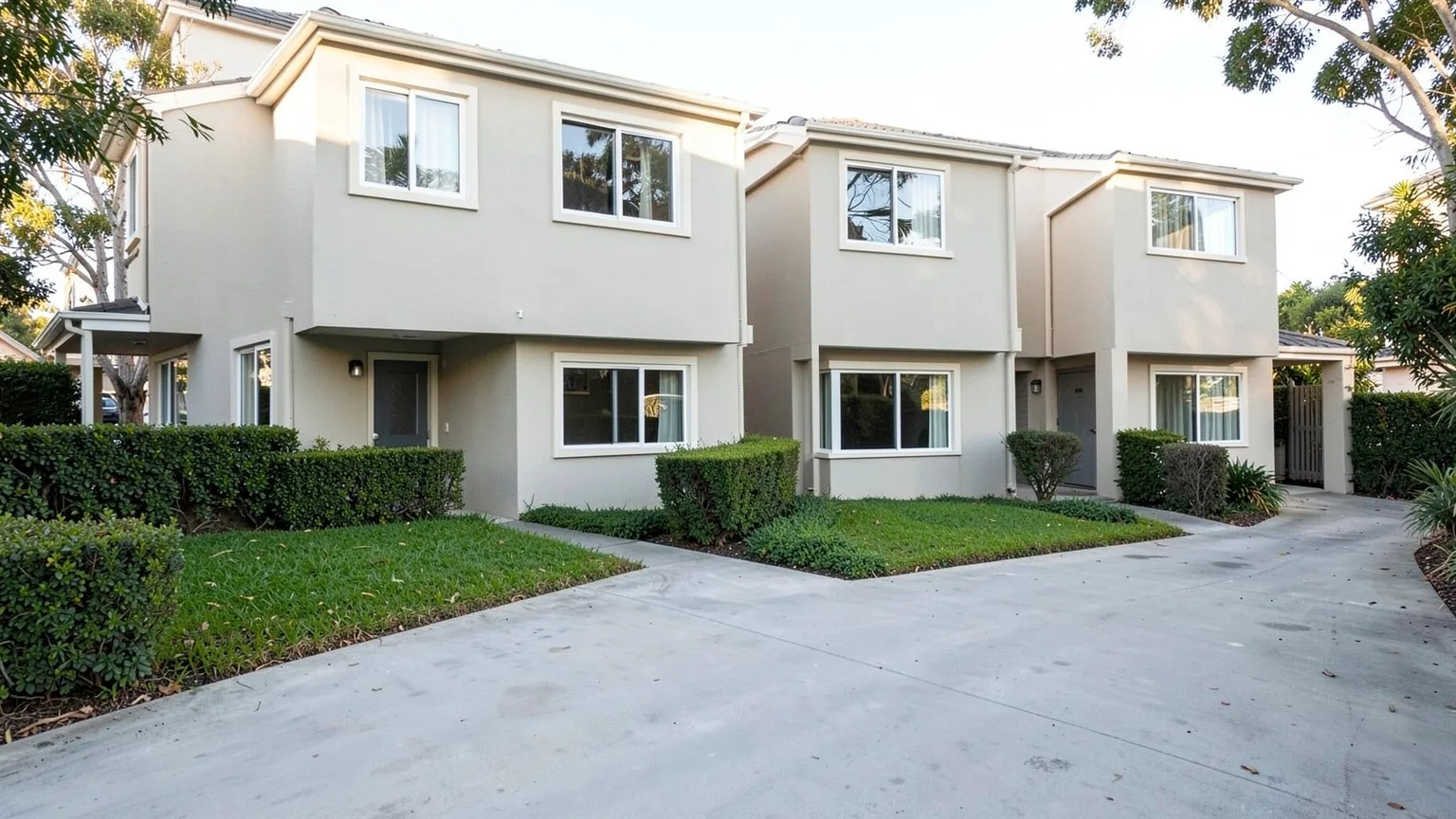
The four-townhouse site promises $200,000 more profit than the duplex. It is tempting to call that the better first project. But how much extra cash must you commit, how long is it tied up, and what happens if the ground costs more than expected?
At Stage 5, Financial Feasibility, compare two actual development strategies against the same available cash. The useful question is which opportunity you can carry through a problem while still earning enough to justify the work.
Compare two purchases, not just two profit figures
Consider buying a NSW site for a side-by-side duplex, or a different site for four townhouses with a shared driveway. Both strategies would sell every finished home. The NSW planning department explains that an attached dual occupancy has two homes sharing a wall, while multi-dwelling housing includes three or more ground-access homes on one lot. Those descriptions do not establish permission for either site.
Have a planner and designer test each layout. Ask the builder about excavation, retaining walls and construction access. Four straightforward homes might be easier to deliver than two homes on a steep block. Dwelling count alone cannot tell you which project is manageable.
A worked example: more profit, less breathing room
Hypothetical teaching example, in Australian dollars. Assume $1 million of project cash is available after setting aside household needs. These are invented figures, not market prices, quotes, approvals or loan offers.
| Comparison | Duplex | Four townhouses |
|---|---|---|
| Total sales | $2,400,000 | $4,400,000 |
| Total project costs | $2,050,000 | $3,850,000 |
| Profit before income tax | $350,000 | $550,000 |
| Purchase to final settlement | 18 months | 24 months |
| Maximum own cash needed | $550,000 | $850,000 |
| Cash left outside the project | $450,000 | $150,000 |
Costs include land and buying costs, design, approvals, building, services, finance, holding, selling, contingency and an assumed net GST allowance after credits. An accountant would replace that allowance with project-specific calculations.
Maximum own cash means the most money the student must put in before settlements return funds, after assumed loan drawdowns. It includes funding the budgeted contingency and temporary GST cash needs. It is an input from an assumed monthly forecast, not total costs minus an advertised borrowing percentage.
Australian Government cash-flow guidance explains how forecasting money coming in and going out helps identify shortages. For development specifically, CommBank's published business-finance terms, pages 26–27, describe a development budget covering costs, sales and their timing. Neither source confirms funding for this example.
The bigger project offers $200,000 extra profit, needs $300,000 more of the student's cash and takes six months longer. That is the trade to investigate. Dividing profit by months would hide when cash is committed and how exposed it becomes.
Can you fund the problem and finish?
Now assume unexpected ground works exceed the contingency already allowed. The extra cost is $120,000 for the duplex and $200,000 for the townhouses. Both settle three months late, adding assumed interest and holding costs of $8,000 and $15,000 per month respectively.
The duplex needs another $144,000: $120,000 plus $24,000. Its profit falls to $206,000, and cash left falls to $306,000. The townhouses need another $245,000: $200,000 plus $45,000. Their profit remains higher at $305,000, but the available $150,000 leaves a $95,000 funding gap. Assume no extra borrowing and all additional costs fall before sales settle.
Suppose this student also wants $100,000 untouched after that setback. This is their chosen reserve, not a universal safety rule. The townhouse option needs $195,000 more available cash to cover the gap and preserve that reserve.
On these assumptions, investigate the duplex further and pause the townhouse purchase. Revisit the larger option only if verified changes close that $195,000 gap and its remaining profit is worthwhile. Extra partner capital would also change the student's profit share. Reject both if neither meets your limits.
WHAT WOULD A TPC STUDENT DO?
- Obtain two workable concepts, matching sold-home evidence and builder estimates for the separate sites.
- With a broker and accountant, compare monthly own-cash needs, total profit and time to final settlement.
- Ask the engineer and builder to price the biggest unresolved site problem, then add a realistic delay.
- Choose the opportunity that meets your profit target and preserves your chosen cash reserve; revise or pass where it does not.
Sources and notes
Sources checked 22 November 2026.
- NSW Department of Planning — Unpacking low-rise housing — Supports the physical distinction between attached dual occupancy and multi-dwelling housing only; not relied on for current reform status, site permission, dimensions or approval timing.
- Australian Government — Set up a cash flow statement — Supports forecasting cash inflows and outflows to identify shortages, explaining estimates and stating GST treatment; does not substantiate the hypothetical amounts.
- CommBank — Business Finance Terms issued 3 December 2025, pages 26–27 — Property Development Budget definition includes costs, sales income and their timing; used for lending education, not a claim that this version governs a reader or establishes a facility, rate or borrowing limit.
Every amount, duration, cash commitment, setback and reserve is a hypothetical teaching assumption. No actual project, comparable sale, quotation, finance approval or outcome is represented. Profit is before income tax, with an assumed net GST cost allowance; the separate cash forecast also allows for temporary GST funding needs. Additional setback costs are beyond existing contingency and assumed to require cash before settlement without extra borrowing.
Archive comparison: the peak-debt guide explains a single project cash curve; the sensitivity guide tests adverse changes; the contingency guide explains allowances; the small-site guide screens opportunities. The latest three-versus-four-townhouse guide compares layouts on one site, and the flat-market duplex guide separates profit from price growth. This article compares separate acquisition choices against one fixed cash pool and calculates the extra capital required to keep a chosen reserve even when the larger project remains more profitable.
The live blog index, current seed archive and closest complete articles were inspected. The page=47 URL was unavailable through the browsing tool; the supplied duplex and due-diligence references were opened live for subject and language. Production metadata uses the requested 22 November 2026 date. Live source retrieval occurred on 21 November 2026.
The earlier job review described the same useful decision but reported a cover-scene failure. No prior article-source file was located in the current package or seed archive. This source specifies one physical duplex subject for the host to create and review; it carries no image approval.
General development education. Confirm site suitability, costs, funding and tax treatment with qualified advisers.
 Learn with Jason & AmyBuild practical small-scale property development skills with experienced mentors.Enquire now
Rate this article
Guest rating: select 1 star for poor or 5 stars for great. No account is required.
Leave a comment
Join the discussion. Your email address will not be published.
Frequently asked questions
Is a duplex always the better first development?
No. Site conditions, design, buyer demand, funding and your ability to handle problems matter more than the dwelling count. A difficult duplex can be harder to deliver than a straightforward townhouse project.
Why can the more profitable project be out of reach?
Profit arrives after the project costs have been funded. In the example, the townhouses still show $305,000 profit after the setback but lack $95,000 cash to finish without extra funding.
Is the cash reserve the same as contingency?
Here, contingency is already inside the cost budget and funded within the own-cash requirement. The separate reserve stays outside the project, available if costs exceed that allowance.
How much extra cash would the townhouse option need?
Under the example assumptions, $95,000 closes the funding gap. Another $100,000 preserves this student’s chosen reserve, so the total extra cash needed is $195,000.
Would bringing in a partner solve the choice?
It could change the available capital, but the partner’s share changes what the student earns. Recalculate personal profit, cash exposure and responsibilities before comparing the opportunities again.
Loading comments…