
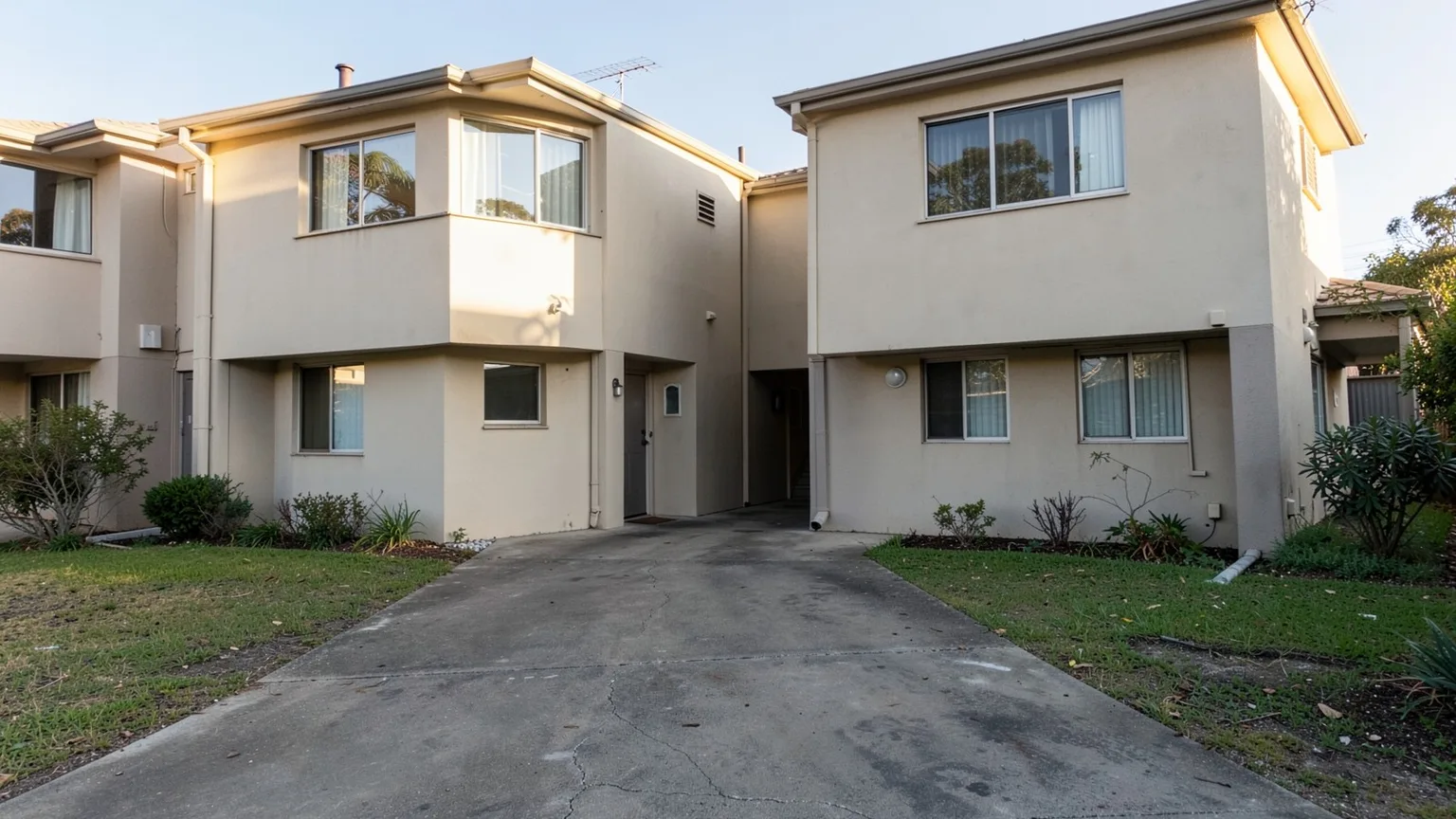
A duplex can look like a good deal because the spreadsheet quietly gives the market a job: lift the selling prices before construction finishes.
Before buying the site, ask how much profit remains if that lift never comes. You may still have a useful development opportunity. You may also discover that most of the reward depends on something you cannot control.
Price the homes you will actually sell
At Stage 5, Financial Feasibility, a student considering a NSW knockdown duplex needs evidence for two completed homes at today's prices. The old house's value is only the starting point.
Compare recent sales of similar attached homes, including their living space, parking, gardens and finish. A sale of a larger freestanding house needs careful adjustment. Ask a local valuer to explain which sales support each proposed home.
The NSW Government says its recorded sales information comes from Notices of Sale lodged with Land Registry Services. Use appropriately licensed data for commercial work. A recorded price still needs interpretation; it does not tell you whether the home matches your design.
If comparable new homes already command a higher price than older homes, that benefit belongs in today's finished-home value. Do not add it again as future growth simply because you are building something new.
One duplex, three different profit figures
Hypothetical worked example, in Australian dollars: a student proposes replacing an older NSW house with two similar duplex homes and selling both. Assume an eighteen-month project. These are teaching figures, not local prices, quotes or an approved project.
Assume conservative current sales of $1.05 million per home. Total project costs are $1.98 million: land and buying costs $850,000; demolition, building and site works $850,000; design and approvals $90,000; finance and holding $80,000; selling and net GST allowance $60,000; contingency $50,000.
The hopeful version uses $1.15 million per home. Allow another $20,000 for the selling and net GST effects of higher prices, taking costs to $2 million. These allowances need project-specific calculations from the agent and accountant.
| Scenario | Total sales | Total costs | Profit before income tax |
|---|---|---|---|
| Prices rise as hoped | $2,300,000 | $2,000,000 | $300,000 |
| Today's prices, on time | $2,100,000 | $1,980,000 | $120,000 |
| Today's prices, six months late | $2,100,000 | $2,028,000 | $72,000 |
The project shows $120,000 at current prices. The extra $180,000 depends on higher selling prices, after the changed allowances. That means 60% of the headline $300,000 profit relies on growth.
The delayed version adds six months at an assumed $8,000 a month in extra interest and holding costs: $48,000. It leaves contingency untouched and assumes no other changes. A broker would calculate actual delay costs from the debt outstanding and loan terms at that stage.
Find the change that would make it worthwhile
Suppose this student wants at least $200,000 before income tax for the time, capital and risk. That is their chosen minimum, not an industry rule.
The delayed flat-price result is $128,000 short. To meet the target at $2.1 million in sales, total delayed costs must fall to $1.9 million. The student now has a concrete question: can the project genuinely save $128,000?
Start with acquisition price and build design. Ask the builder whether a simpler roof or less complicated structure could reduce costs while preserving the features buyers value. Recheck sales evidence if the proposed homes change. Cutting useful living space may reduce revenue as well as cost.
A $128,000 land-price reduction is not automatically the answer. Buying costs, borrowing and tax allowances may also change. Recalculate the complete project and check that the savings actually close the gap.
Waiting for a better market does not itself repair the deal. ASIC's Moneysmart explains that property values can fall and borrowing and ownership costs affect returns. Its general education is not a development loan offer. Here, every extra month needs $8,000 in additional net proceeds merely to cover the assumed extra costs.
If supported savings cannot meet the target, the student passes on the site. A positive profit can still be too small for the project. Flat prices are also only one test; falling sales and higher build costs deserve separate scenarios.
WHAT WOULD A TPC STUDENT DO?
- Ask a local valuer for current sales evidence matching each finished duplex home.
- With the builder, broker and accountant, calculate current-price profit, growth-dependent profit and a delayed exit.
- Set a minimum profit, calculate the shortfall and pursue only savings supported by revised prices or estimates. Pass if the deal still needs growth to qualify.
Sources and notes
Sources checked 21 November 2026.
- NSW Government — How to find property sales information — Explains the Notice of Sale origin of NSW sales records, access tools and commercial licensing restrictions; does not establish comparable duplex values.
- ASIC Moneysmart — Buying an investment property — General education on property value risk, borrowing, buying, selling and ownership costs; not development lending guidance, a price forecast or support for the example figures.
All project amounts, sale prices, duration, delay costs, allowances and the minimum profit are hypothetical teaching assumptions. No real site, deal, comparable sale, valuation, approval, finance offer or result is represented. Profit is before income tax; simplified costs include an assumed net GST allowance after credits rather than an asserted tax rate.
The NSW source explains sales data and usage terms rather than product comparability or planning rights. Moneysmart supplies general property risk and cost education; its investment mortgage examples are not development finance terms. No forecast of Australian property prices is made.
Archive comparison on 21 November 2026: inspected the live blog index and local seed archive. The feasibility guide covers full costs; the sensitivity guide tests five adverse changes; the timeline guide prices delay; the residual-land-value guide works back to an offer ceiling; the comparable-sales and development-margin guides explain evidence and buffers. The three-versus-four-townhouse guide compares layouts and a switching sale price. This article adds an explicit dollar and percentage split between current-price project profit and growth-dependent profit, then calculates the total cost saving needed to meet a chosen profit target after a flat-price delay. It does not present merely another generic stress-test checklist.
The four supplied teaching-reference articles were inspected for practical subject matter in the seed archive, with the duplex and due-diligence references also opened live. The page=47 URL returned an accessibility error in the browsing tool; no claim is made to have retrieved that page. Existing job revisions were read as candidate evidence only. Their image approvals and assets are not carried into this source. Cover creation and review remain with the host.
General development education. Confirm site suitability, values, costs, funding and tax treatment with qualified advisers.
 Learn with Jason & AmyBuild practical small-scale property development skills with experienced mentors.Enquire now
Rate this article
Guest rating: select 1 star for poor or 5 stars for great. No account is required.
Leave a comment
Join the discussion. Your email address will not be published.
Frequently asked questions
Can a duplex make money without rising property prices?
Yes, if sales at current finished-home values exceed all project costs. Whether that profit justifies the time, capital and risk is a separate decision.
Why does 60% of the example's profit depend on growth?
The hopeful case leaves $300,000 and the current-price case leaves $120,000. The $180,000 difference is 60% of $300,000, allowing for the example's changed selling and net GST costs.
Is the higher value of a new home the same as market growth?
No. A higher price already supported by comparable new-home sales belongs in today's finished-home value. Market growth means assuming that value rises before your sale.
Why must the delayed example save $128,000?
Its $72,000 profit is $128,000 below the student's chosen $200,000 minimum. At unchanged sales, reducing total delayed costs from $2,028,000 to $1,900,000 closes that gap.
Is $200,000 the right minimum profit for every duplex?
No. It is a teaching assumption for this student. Set a requirement that reflects your capital, time, funding and project risk before deciding whether to pursue a site.
Loading comments…