
Almost every feasibility carries a line for 'compliance' and almost none carries a line for 'which edition'. That is the gap. The National Construction Code is written once nationally and adopted separately by each state and territory, on dates that now span more than a year. A national headline date is not an answer about your site, and getting it wrong can mean redesign and repricing after the plans are drawn.
The deal question: what date decides the edition for this project?
The first question is not which edition is newest. It is which edition the authority will apply to your approval, and what event fixes that: the lodgement of a building permit or construction certificate application, the grant of the approval, or the start of construction. The ABCB's adoption page sets out the national position. It records NCC 2025 as published on 1 May 2026, with Victoria and Western Australia adopting from 1 May 2026, Western Australia with a 12-month transition; the Australian Capital Territory from 1 May 2026 with a 12-month transition; New South Wales and Queensland from 1 May 2027; South Australia with the Building Code of Australia from 1 May 2027 and the Plumbing Code of Australia from 1 May 2026; Tasmania from 1 May 2027 after a temporary adoption between 1 May and 4 June 2026; and the Northern Territory as not adopting NCC 2025 at all.
Read the spread rather than the individual dates. A developer working in Victoria and one working in New South Wales can be designing the same duplex in the same month under different editions of the same code. The ABCB says as much itself: it warns that some NCC requirements may apply at different times or not at all because of state or territory variations. That warning is the single most useful line on the page.
What actually changed, so you know what you are managing
NCC 2025 is not a wholesale rewrite of residential requirements. The ABCB's key changes index lists what it has documented in this edition: commercial energy efficiency, carpark fire safety, water management, condensation mitigation, sanitary facilities, structural reliability and fire safety Performance Solutions, and plumbing and drainage. Where your project is residential, the condensation and water management items are the ones most likely to touch design.
The water management change is structural as well as technical. The ABCB records that Part F1 and Part F3 were merged into a single Part F1, that Performance Requirements F3P1 and F1P1 to F1P4 were consolidated and replaced with a single Performance Requirement F1P1, and that the objectives and performance requirements now cover surface and sub-surface water explicitly. It also records why: the ABCB's research showed that most water-related defects result from sub-surface water, which typically affects buildings from below ground level or beneath finished surfaces such as balconies, podiums and concrete roofs. It adds that a new provision for 10-year deflection was introduced in Part B1.
On condensation, the ABCB records that NCC 2025 strengthened the provisions in Volume One Part F8 and Housing Provisions Part 10.8, expanded vapour permeance requirements by climate zone and wall construction, made wall cavities mandatory in climate zones 6, 7 and 8, added exemptions for insulated sandwich panels and walls that are not part of the building envelope, and revised roof ventilation based on whether the insulation runs parallel to the roof plane. Its stated reason is blunt: condensation has been identified as a significant contributor to building defects, particularly in cooler and mixed climates and in modern, more airtight buildings. If your design was drawn to an earlier edition, those are the items to re-check first.
A worked example of why the variation matters more than the date
Two jurisdictions can run different editions of the same part at the same time, and the Housing Provisions are the plainest place to see it. Part 13.2 Building fabric carries a Western Australian replacement clause, and its explanatory note allows climate zone 6 to be considered as climate zone 5 for Parts 13.2 and 13.3 only. So a house in the same climate zone on either side of a border can be designed to a different insulation assumption, and the note is careful to say that provisions on services selection and condensation management are unaffected by that substitution.
Volume Two shows the same behaviour. Part H6 Energy efficiency sets two Deemed-to-Satisfy pathways — an energy rating under Specification 42, or the elemental provisions in Housing Provisions Parts 13.2 to 13.7 — and it also carries a Western Australian note that NCC 2019 Volume Two Amendment 1 Parts 2.6 and 3.12.5 may apply instead of Part H6 for certain alterations, extensions and swimming pools associated with an existing building. A national code, a state pathway.
The trap: assuming the newest edition is the one that applies
Three failure patterns recur. The first is designing to the newest national edition when the jurisdiction has not adopted it, which buys cost you did not need. The second is the opposite: designing to the older edition when the jurisdiction has already moved, or when a transition period ends mid-program, so the design is non-compliant by the time the permit is assessed. The third is the program risk nobody prices — a transition date that falls between lodgement and construction, where the rules can change under a project that is already in the ground.
The ABCB's own page is deliberately explicit that its table is a starting point: requirements may apply at different times, and its advice is to visit the jurisdiction's own source. Treat the national table as the map and your certifier's written answer as the instruction.
Checks a capable student would run
- Identify the state or territory for the site and write it into the feasibility, alongside the edition the project will be assessed under.
- Ask the certifier which event fixes the edition — permit application, approval or commencement — and get the answer in writing with the date it was given.
- Check the jurisdiction's own current adoption or transition page rather than relying on the national table.
- Diff the design against the items the ABCB lists as changed: water management, condensation, carpark fire safety, commercial energy, sanitary facilities and structural reliability, limited to the classes that apply to your project.
- Test the program: if approval or construction slips past an adoption or transition date, what changes, and who pays?
- Price the difference once, deliberately, between designing to the earlier and the later edition, so the decision is made with numbers rather than discovered later.
- Record the edition, the variation and the date checked in the feasibility assumptions register so the next person can audit it.
Key takeaway
NCC 2025 was published on 1 May 2026 and is adopted by each state and territory on its own date, with Western Australia and the ACT also carrying 12-month transitions and the Northern Territory not adopting it. For any project, the only question that matters is which edition and variation the authority will apply, fixed by a specific event in the approval or construction program. Answer that in writing before the design hardens, and record it as an assumption with an expiry date rather than a fact.
A question to ask yourself
Can you name the event that fixes the NCC edition for your project, and the date it falls?
Sources and boundaries
Sources checked 3 October 2026. Jurisdiction and limits: The ABCB's NCC 2025 state and territory adoption page, its NCC 2025 key changes index and its published condensation and water management change summaries, together with NCC 2025 Volume Two Part H6 and ABCB Housing Provisions Part 13.2 as published online, all read on 3 October 2026. State and territory legislation, transitional regulations, building permit and approval processes are administered by each jurisdiction and are not reproduced here. Whether a particular project is captured by a particular edition on a particular date is a matter for the relevant authority and your certifier.
- NCC 2025 state and territory adoption information. Used for: The ABCB's adoption table: NCC 2025 published 1 May 2026; Victoria and Western Australia from 1 May 2026 (WA with a 12-month transition); the ACT from 1 May 2026 with a 12-month transition; New South Wales and Queensland from 1 May 2027; South Australia (Building Code of Australia) from 1 May 2027 and (Plumbing Code of Australia) from 1 May 2026; Tasmania from 1 May 2027, having temporarily adopted 1 May to 4 June 2026 with a transition to 1 May 2027; and the Northern Territory as not adopted — plus the ABCB's warning that some requirements may apply at different times or not at all due to state or territory variations (Checked 3 October 2026)
- NCC 2025 key changes. Used for: The ABCB's index of the NCC 2025 changes it has documented, including commercial energy efficiency, carpark fire safety, water management, condensation mitigation, sanitary facilities, structural reliability and fire safety Performance Solutions, and plumbing and drainage — the list a developer should scan against their own building class (Checked 3 October 2026)
- NCC 2025 key changes — Water management changes. Used for: That Part F1 and Part F3 have been merged into a single Part F1, that Performance Requirements F3P1 and F1P1 to F1P4 were consolidated into a single requirement F1P1, that the provisions were updated to cover surface and sub-surface water, that limitations on storage-type and factory buildings were removed, and that a new provision for 10-year deflection was introduced in Part B1 (Checked 3 October 2026)
- NCC 2025 key changes — Condensation mitigation changes. Used for: The ABCB's summary of what changed in the condensation provisions of Volume One Part F8 and Housing Provisions Part 10.8, and its statement that condensation has been identified as a significant contributor to building defects, particularly in cooler and mixed climates and in modern, more airtight buildings (Checked 3 October 2026)
- NCC 2025 Volume Two — Part H6 Energy efficiency. Used for: That Part H6 sets two Deemed-to-Satisfy pathways (energy rating under Specification 42, or the elemental provisions in Housing Provisions Parts 13.2 to 13.7) and that a Western Australia note in the Part provides that NCC 2019 Volume Two Amendment 1 Parts 2.6 and 3.12.5 may apply instead for certain alterations, extensions and swimming pools (Checked 3 October 2026)
- NCC 2025 ABCB Housing Provisions — Part 13.2 Building fabric. Used for: That the Housing Provisions carry a WA replacement of Part 13.2 and an explanatory note allowing climate zone 6 to be considered as climate zone 5 for Parts 13.2 and 13.3 only — a concrete example of how the same part can read differently in two jurisdictions (Checked 3 October 2026)
This article is general education, not personalised planning, legal, financial, tax or building advice. Requirements and outcomes vary by jurisdiction, site, contract, structure and circumstances. Check current information with the relevant authority and appropriately qualified advisers.
 Learn with Jason & AmyBuild practical small-scale property development skills with experienced mentors.Enquire now
Rate this article
Guest rating: select 1 star for poor or 5 stars for great. No account is required.
Leave a comment
Join the discussion. Your email address will not be published.
Frequently asked questions
Is NCC 2025 in force across Australia now?
No. The ABCB published NCC 2025 on 1 May 2026 and each state and territory adopts it on its own date. Its adoption page records Victoria and Western Australia from 1 May 2026, the ACT from 1 May 2026 with a 12-month transition, New South Wales and Queensland from 1 May 2027, South Australia with the Building Code of Australia from 1 May 2027, Tasmania from 1 May 2027 and the Northern Territory as not adopting it. Check your own jurisdiction's current position.
What determines which edition my approval is assessed under?
It is set by the relevant state or territory legislation and the event it ties the edition to — typically the building permit or construction certificate application, the grant of the approval, or commencement of work. Your building surveyor or certifier should confirm the trigger and the date in writing for your project.
What changed in NCC 2025 that affects housing?
The ABCB's key changes index lists commercial energy efficiency, carpark fire safety, water management, condensation mitigation, sanitary facilities, structural reliability and fire safety Performance Solutions, and plumbing and drainage. For housing the condensation and water management changes are the most likely to touch design, and the ABCB records that residential energy efficiency requirements were not increased in this edition.
What did NCC 2025 change about water management?
The ABCB records that Part F1 and Part F3 were merged into a single Part F1, that Performance Requirements F3P1 and F1P1 to F1P4 were consolidated into a single Performance Requirement F1P1, that the provisions now explicitly cover surface and sub-surface water, that limitations for storage-type and factory buildings were removed, and that a new provision for 10-year deflection was introduced in Part B1.
Can the same part of the code read differently in two states?
Yes, and Part 13.2 of the ABCB Housing Provisions is a working example. It carries a Western Australian replacement clause, and its explanatory note allows climate zone 6 to be considered as climate zone 5 for Parts 13.2 and 13.3 only, while stating that provisions on services selection and condensation management are unaffected. Always read the state variation with the clause.
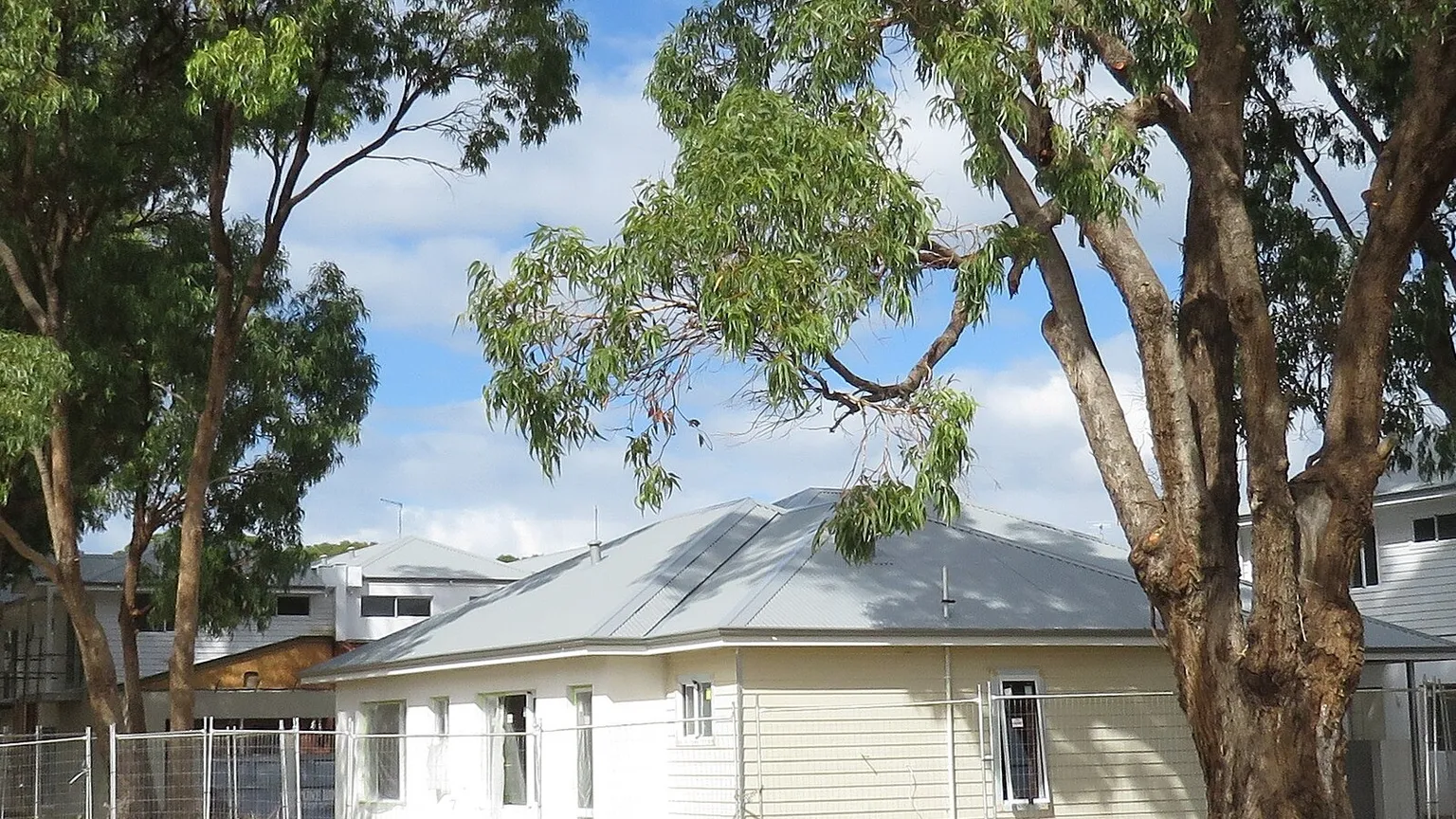
Photo: 'Atwater Estate, Rockingham, Western Australia, April 2026 02' by Calistemon, CC BY-SA 4.0, via Wikimedia Commons.
Loading comments…