
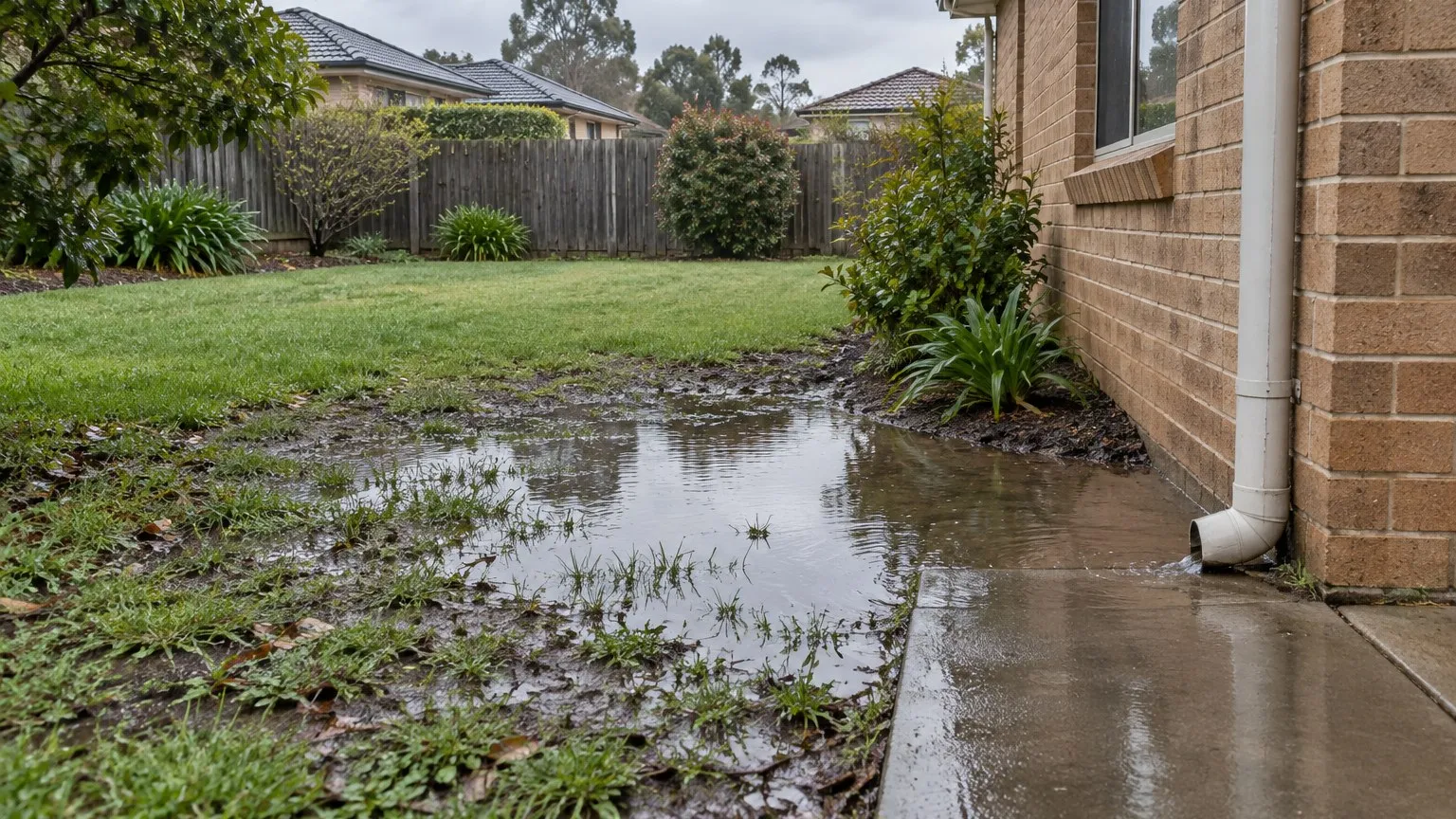
The site is level, the zoning works, the duplex numbers stack up. Then you walk it after a wet week and there is standing water in the back corner. Your drainage consultant mentions on-site detention. You nod, and then you realise you do not know whether that costs you five thousand dollars or one of your bedrooms.
Stormwater is the most underestimated constraint on small infill development in New South Wales, because it is both a cost and a use of land. On a tight site, the second one is what kills the deal.
The deal question: how much of my site does the water take?
Most developers treat stormwater as a plumbing matter handled at construction certificate stage. It is not. On-site stormwater detention is a planning requirement in many catchments, it must be designed and certified before you lodge, and the storage has to physically fit somewhere on the land.
The right due diligence question is not “do I need detention?” It is: how much storage volume, how much land area to hold it at the permitted depth, and what does that do to my yield?
The checks a student would run, in order
- Find out whether the lot is in a detention catchment at all. This is not a general rule; it is mapped. Penrith City Council's stormwater specification (policy ES 002) lists the specific local catchments where on-site detention is mandatory, including Penrith CBD, Penrith North, Lemongrove, Emu Plains, Jamisontown, St Marys, Kingswood and Orchard Hills. If your site is outside those catchments, the obligation changes.
- Check the flood and overland flow position. Overland flow is separate from detention and often more restrictive. Penrith's specification requires minimum freeboard of 500 millimetres above the 1% AEP flood level for residential floor levels. Bayside Council's Part 10 stormwater guidelines require a flood study or overland flowpath assessment with the development application where the site adjoins an identified major overland flow path, sits at or near a catchment sag point, or has any part below 4 metres AHD. Bayside also provides that no structures or fill are permitted over the 1% AEP overland flow path without approved mitigation.
- Get the storage number, not a guess. Where a simplified method applies, some councils publish the parameters. Penrith publishes permissible site discharge and site storage requirement rates by land use — for multi-unit housing, 120 litres per second per hectare discharge and 240 cubic metres per hectare of storage. On an 800 square metre site, that is roughly 19 cubic metres of storage. Sydney Water's on-site stormwater detention guidelines note that Sydney Water will calculate and advise the permissible site discharge and site storage requirement for a given address when supplied with the site area and the pre- and post-development impervious areas.
- Check how shallow the storage has to be. This is the step that decides the land take. Penrith caps above-ground storage depth at 200 millimetres in hardstand areas used for parking and pedestrian access, and 600 millimetres in landscaped areas. Nineteen cubic metres at 200 millimetres needs roughly 95 square metres of surface. Even at 600 millimetres, it needs over 30 square metres. That is where a car space or a courtyard goes.
- Find out where storage is not allowed. Penrith states that storage is not permitted in private courtyards, overland flow paths or floodways, natural watercourses or effluent disposal areas. A bypass allowance exists but caps how much of the site may drain elsewhere — 15% of total site area under both Penrith's and Bayside's guidelines.
- Confirm the discharge point and its capacity. City of Sydney's stormwater drainage manual limits the maximum permissible site discharge to 25 litres per second for storms up to the 20-year ARI. Penrith applies a maximum of 25 litres per second at any single discharge point. If the kerb cannot take the flow, you may be extending or upgrading the council's network at your cost.
- Check the title consequences. Detention is not just a cost; it can encumber the title. City of Sydney's manual states that “a positive covenant must be registered on the title of the land for all drainage systems involving OSD to ensure maintenance of the approved OSD system, regardless of the method of connection”. Bayside requires the stormwater management plan and design certification to be prepared by an accredited professional as part of the development application.
The order, and why it is the whole lesson
Do it this way and each step narrows the next. Catchment first, because it tells you whether you have an obligation at all. Flood and overland flow second, because they can override everything else — a flow path through the middle of your site changes the usable area before detention even gets considered. Numbers third, because they let you calculate land take. Depth fourth, because depth is what converts a volume into an area. Title last, because it is the thing that outlives the project.
Reverse this order — design the building, then ask a civil engineer to make the stormwater fit — and you will be redrawing the scheme at documentation stage, which is the most expensive possible time to redraw it.
The trap: measuring the cost in dollars instead of square metres
The emotional trap on stormwater is fixating on the invoice. Developers ask “what will detention cost?” and budget a number. The invoice is the smaller problem.
Take the illustrative 800 square metre site. Nineteen cubic metres of storage, constrained to 200 millimetres in hardstand or 600 millimetres in landscaped areas, cannot sit in courtyards or overland flow paths. So it consumes yard, a parking space, or a strip of the site you had allocated to something else. Add the freeboard requirement — 500 millimetres above the 1% AEP flood level in Penrith's case — and floor levels may rise, reducing achievable height and forcing split-level or basement solutions that cost far more than the tank.
Meanwhile the site that cannot bypass more than 15% of its area has to detain almost everything, which can mean the difference between two dwellings and one, or between a driveway you can use and one you cannot.
Cost, timing and feasibility implications
- Land take. Storage volume divided by permitted depth gives you a footprint. That footprint competes directly with dwellings, parking and private open space.
- Design cost. Councils require a stormwater concept plan, calculations and certification with the application. Penrith warns that failure to provide a satisfactory plan “may result in your application being rejected or refused”. Bayside requires a flood study or overland flowpath assessment signed by an engineer declaring it follows Australian Rainfall and Runoff and the NSW Floodplain Development Manual.
- Floor levels. Freeboard requirements lift habitable floor levels above the design flood level, which changes the building, not just the plumbing.
- Title encumbrance. A positive covenant on title is a permanent feature of the product you are selling, and it affects the buyer's future maintenance obligations.
- Program. Flood studies and engineering certification sit on the critical path to lodgement, and a Sydney Water compliance certificate is generally needed before an occupation certificate.
The Think Property Club lesson
Stormwater teaches the discipline of asking a constraint to show you its land take, not just its price. On any small site, the question “how much of this block does it consume?” is the one that decides feasibility, and it can be answered before the offer with a catchment map, a flood level enquiry and a storage calculation.
That is repeatable, evidence-based due diligence — and it is exactly the check a capable student runs before falling in love with a yield figure.
Your next actions before you make an offer
- Order a section 10.7 planning certificate and a council flood level enquiry for the address.
- Check whether the lot sits in a mapped detention catchment or is served by a stormwater asset that requires approval to connect.
- Get the permissible site discharge and site storage requirement in writing, with the site areas supplied.
- Calculate the land take at the permitted storage depth, and test it against your layout.
- Walk the site for overland flow: upstream catchment, sag point, lowest point, discharge point.
- Confirm the discharge capacity at the connection point, and whether any boundary fence over a flow path must be open-type.
- Ask your solicitor about the practical effect of a positive covenant on the title before you resell.
Reader question: if your stormwater storage had to sit at 200 millimetres deep, where exactly on your site would it go?
Sources and boundaries
Sources checked 23 September 2026. Jurisdiction and limits: New South Wales only, and the requirements described are council-, catchment- and asset-specific: they are the published documents of Penrith City Council, Bayside Council, the City of Sydney and Sydney Water as retrieved at the checked date. Detention catchments, permissible site discharge, site storage requirement, freeboard and documentation requirements differ between councils and are periodically amended, so the applicable numbers for a specific site must be confirmed with the relevant council and with Sydney Water. Overland flow and flood planning levels can only be confirmed from the individual council's flood study or mapping, a section 10.7 planning certificate, or a council flood level enquiry — not from a general manual. Whether a Sydney Water section 73 compliance certificate is required depends on the site and the works.
- Penrith City Council — Stormwater Drainage Specification for Building Developments (Policy ES 002). Used for: the catchments where on-site detention is mandatory, the published permissible site discharge and site storage requirement rates, the maximum above-ground storage depths, the freeboard table, the documentation required with a development application, and the 15% bypass limit (Checked 23 September 2026)
- Bayside Council — Part 10 Stormwater Management Technical Guidelines, Botany Bay DCP 2013 (Amendment 9). Used for: the on-site detention obligation, the permissible site discharge basis, the freeboard requirements, the flood study and overland flowpath assessment triggers, the restriction on structures over the 1% AEP overland flow path, and the accredited professional certification requirement (Checked 23 September 2026)
- Sydney Water — On-site stormwater detention: guidelines (DD_070266 SW201). Used for: which developments require on-site stormwater detention, that each lot within a dual occupancy must have its own system, and the permissible site discharge and site storage requirement information Sydney Water will provide (Checked 23 September 2026)
- City of Sydney — Stormwater Drainage Manual (February 2017). Used for: that dual occupancy and strata subdivisions require on-site detention, the maximum permissible site discharge to kerb, the stormwater details required with a development application, and the positive covenant that must be registered on title (Checked 23 September 2026)
This article is general education, not personalised planning, legal, financial, tax, privacy, safety or building advice. Requirements and outcomes vary by jurisdiction, site, contract, structure and circumstances. Check current information with the relevant authority and appropriately qualified advisers.
 Learn with Jason & AmyBuild practical small-scale property development skills with experienced mentors.Enquire now
Rate this article
Guest rating: select 1 star for poor or 5 stars for great. No account is required.
Leave a comment
Join the discussion. Your email address will not be published.
Frequently asked questions
How do I find out whether my site needs on-site detention before I buy it?
Check the mapping, not the general rules. On-site detention is required in specific local catchments that councils nominate — Penrith City Council's specification lists catchments including Penrith CBD, Emu Plains, Jamisontown, St Marys, Kingswood and Orchard Hills. Order a section 10.7 planning certificate and a council flood level enquiry for the address, and check whether the lot is served by a stormwater asset that requires consent to connect. Sydney Water's guidelines state that you may be required to install on-site detention where you propose to connect or develop a property connecting to a stormwater asset owned by Sydney Water or in the City of Sydney local government area.
How much storage does my development actually need?
It depends on the council's method and the site. Where a simplified method applies, some councils publish the parameters: Penrith City Council publishes permissible site discharge of 120 litres per second per hectare and a site storage requirement of 240 cubic metres per hectare for multi-unit housing. On an 800 square metre site that is roughly 19 cubic metres. Sydney Water calculates and advises the permissible site discharge and site storage requirement for a specific address when given the site area and the pre- and post-development impervious areas. Bayside Council derives storage by modelling to its stated discharge limit rather than publishing a volume table.
Why does storage depth matter so much?
Because shallow storage spreads across a large area, and land is what you are really paying for. Penrith City Council caps above-ground storage at 200 millimetres in hardstand areas used for car parking and pedestrian access and 600 millimetres in landscaped areas. Around 19 cubic metres at 200 millimetres needs roughly 95 square metres of surface — the size of a car space and more. Penrith also prohibits storage in private courtyards, overland flow paths or floodways, natural watercourses and effluent disposal areas, so the storage cannot simply be hidden in the courtyard you were counting on.
Can I just let some of the site drain away without detention?
Only up to a limit, and the limit is strict. Both Penrith City Council and Bayside Council cap the area permitted to bypass the detention system at 15% of total site area. If more of the site cannot be directed to the system, the storage generally has to be enlarged and the outlet control revised so total runoff still meets the permissible site discharge for the whole site. There is one offsetting factor: where a site is impacted by an identified major overland flow path, Penrith may delete or reduce the detention requirement and may allow the flow-path area to be excluded from the site area used to calculate discharge and storage.
Does on-site detention leave a permanent mark on my title?
Yes, in many cases. City of Sydney's stormwater drainage manual states that a positive covenant must be registered on the title of the land for all drainage systems involving on-site detention, to ensure maintenance of the approved system, regardless of the method of connection. Bayside Council requires the stormwater management plan and its design certification to be prepared by an accredited professional as part of the development application. Those obligations follow the lots into sale, so they are a product feature your buyer will inherit, not just a construction cost.
Loading comments…