
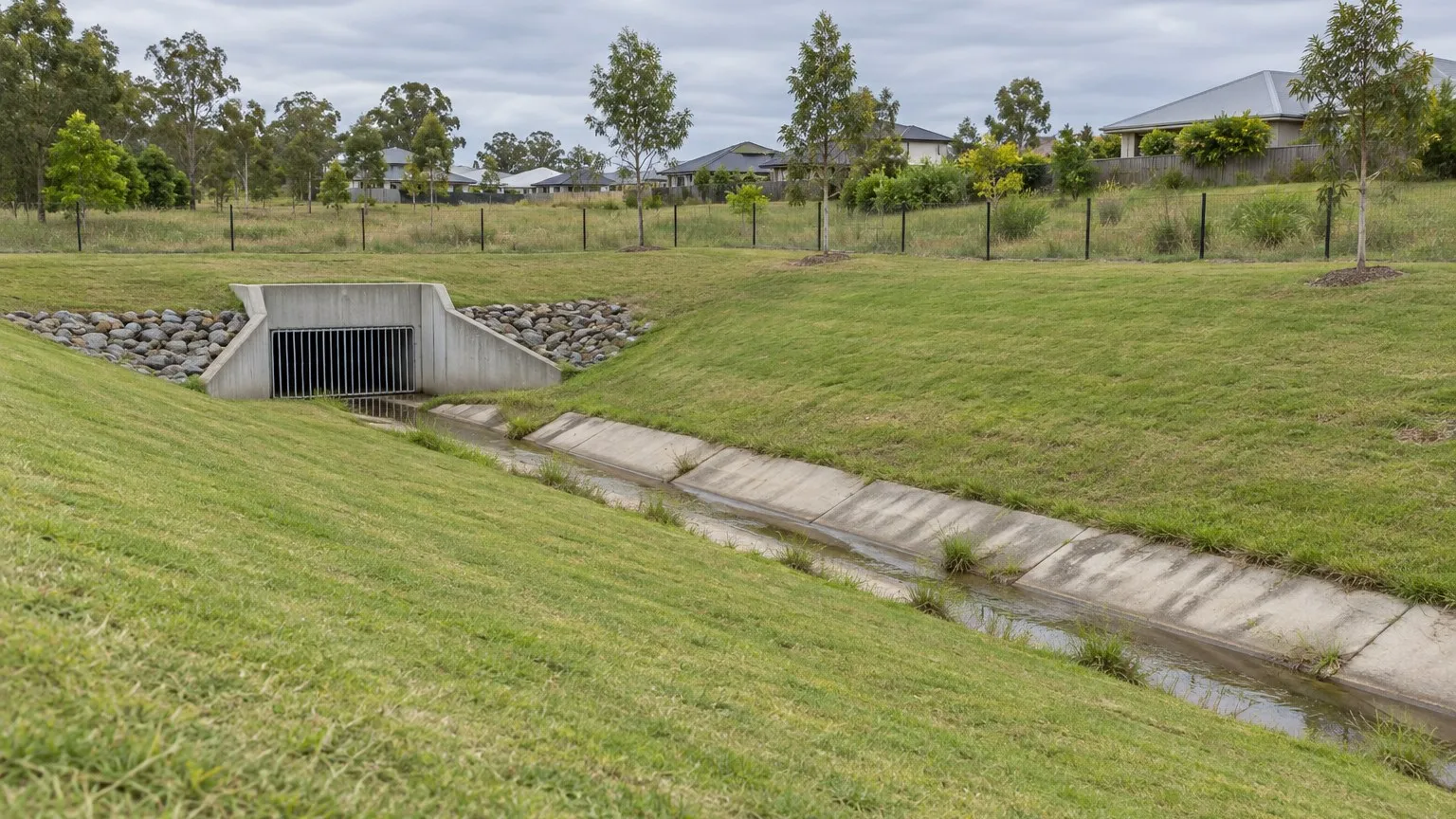
Your reconfiguring-a-lot approval arrives. The surveyor is booked, the civil contractor has priced the drainage, and the builder wants to start. Then someone asks for the operational work permit, and nobody knows what that is.
In Queensland this is one of the most common sequencing failures on a small subdivision, and the consequence is not a fine to be argued later. It is that the works should not be starting at all.
The deal question: which approval authorises the work you are about to do?
Queensland separates the decision to subdivide from the approval to build the civil works. The Planning Act 2016 defines operational work in schedule 2 as work, other than building work or plumbing or drainage work, in, on, over or under premises that materially affects premises or the use of premises, and defines reconfiguring a lot to include creating lots by subdividing another lot. The current in-force text of the Planning Act 2016 carries both definitions, and the authorised PDF of the same Act carries the identical wording, so you can check the definitions against the official text rather than a summary.
So the question that decides whether your programme is real is simple: do you hold a permit that is in effect authorising the earthworks, drainage, roadworks and landscaping your contractor is about to start?
The checks a student would run, in order
- Read the conditions of the approval you already hold. Look specifically for conditions requiring works to be carried out, or requiring a further application before works commence.
- Determine whether the works are operational work. Apply the schedule 2 definition and then the planning scheme's tables of assessment for your zone and overlays.
- Establish the assessment category. Check whether the operational work is accepted development, code assessable or impact assessable in your council's scheme.
- Check whether the condition is minor or self-certified. Some conditions genuinely do not require a separate application. Read the actual wording.
- Build the documentation pack before you lodge. Drawings, stormwater and hydraulic reports, erosion and sediment control plans and geotechnical information all take time.
- Confirm whether engineering certification is required. Check your own council's requirements for drawings and reports.
- Check the service authority permits separately. Water and sewer reticulation and electrical and telecommunications supply are often additional permits, not part of the council approval.
- Set the builder's start date after the permit is in effect. Programme the approval, not the intention to obtain it.
Why two approvals exist, and what that costs you
Brisbane City Council describes the two types clearly. Operational work is a type of development permit issued by council, assessed under the timeframes stated in the Development Assessment Rules. Council states that you usually need operational work approval for any works conditioned under a reconfiguring a lot approval, which it calls post-approval operational work, and that the other type is stand-alone operational work, which covers filling or excavation and vegetation management that may not relate to a reconfiguration, with assessment triggers listed in Part 5 of Brisbane City Plan 2014. The Brisbane City Council operational work application guidance sets this out.
For a developer this is not just another fee. It is a second assessment that consumes professional time, a second set of drawings, and a second decision timeframe, and it sits between your subdivision approval and your ability to lawfully build. Where an approval is code assessable because the documentation is complete, the timeframe is one thing. Where a report is missing and the application comes back, the calendar is another. Add the service authority permits on top and the pre-construction phase can be longer than the construction itself.
The trap: a builder's programme that assumes the site is ready
The failure mode is rarely a decision to break the law. It is a contract signed with a start date that assumes the permit will exist by then. The civil contractor mobilises because the programme says so, and work begins on assessable development without the necessary permits in effect. Section 163 provides that a person must not carry out assessable development unless all necessary development permits are in effect for the development, with a maximum penalty of 4,500 penalty units, or 17,000 penalty units where the assessable development is on a Queensland heritage place or local heritage place. Those exceptions are narrow, and an optimistic programme is not among them.
The second trap is assuming the operational works documentation is the engineer's problem. It is your application. If the drawings are not certified, or the erosion and sediment control planning is not at the standard the scheme requires, the application is incomplete and the timeframe resets. Different councils also require different certification: some require drawings and specifications to be checked and signed by a Registered Professional Engineer of Queensland, and some require specialist certification for erosion and sediment control on high-risk sites. Confirm your own council's list before you brief the engineer.
How to brief this properly
You are not expected to interpret the Planning Act 2016, classify your own development against the tables of assessment, or design a stormwater system. Your job is to sequence the approvals correctly and to hold your team to that sequence. A town planner should confirm whether operational work is triggered, what the assessment category is, and whether any condition of your existing approval is minor or self-certified. A civil engineer should prepare the drawings, stormwater and earthworks design, and erosion and sediment control documentation, and a licensed surveyor or civil engineer should confirm levels, access, drainage and servicing. A property lawyer should review the approval conditions and the construction contract so that the builder's start date cannot precede the permit. All of them should work from your council's current scheme and fee register, not from a general description like this one.
Practical next steps checklist
- Re-read every condition of your current approval for works and further-application requirements.
- Confirm with your council whether the works are operational work and in which assessment category.
- Check whether any condition is stated to be minor or self-certified.
- Assemble the engineer's drawings, reports and sediment control documentation before lodging.
- Confirm whether engineering certification is required in your council area.
- Apply separately to the water, sewer, electricity and telecommunications authorities.
- Set the contract start date only after the permit is in effect.
- Carry the assessment timeframe, documentation preparation and any refusals in the project programme.
Key takeaway
In Queensland a subdivision approval and an operational work permit are two different decisions. The civil works need their own permit in effect before they start, the penalty for getting that wrong is statutory, and the way this fails in practice is a construction programme written before the sequencing was confirmed. Let your planner classify it and your engineer document it, and hold the builder's start date behind the permit.
Reader question: on your last Queensland project, did the operational work permit sit in the programme, or did it arrive as a surprise after the contractor was booked?
Sources and boundaries
Sources checked 26 September 2026. Jurisdiction and limits: Queensland specific information, with one local government example. The statutory definitions of operational work and reconfiguring a lot and the terms of section 163 are taken from the current in-force text of the Planning Act 2016 (Qld) as retrieved at the checked date. The operational work types, assessment triggers, documentation requirements, certification requirements and timeframes quoted as practical examples are taken from Brisbane City Council's own operational work application guidance and from Brisbane City Plan 2014, and those are local to Brisbane City Council. They do not set a statewide rate, trigger or document list: each local government in Queensland applies its own planning scheme, tables of assessment, codes and register of fees, and different councils in this state have different triggers for filling and excavation, vegetation management and driveway crossovers. Requirements also change, and conditions of approval are site and application specific. Nothing here applies outside Queensland. This is general information only. Confirm the current requirements and the conditions applying to your approval with the relevant council, your town planner, your civil engineer and your own legal advisers before you contract or start work.
- Queensland — Planning Act 2016, current in-force text (definitions and section 163). Used for: the dictionary definition in schedule 2 that operational work means work, other than building work or plumbing or drainage work, in, on, over or under premises that materially affects premises or the use of premises; the definition that reconfiguring a lot means creating lots by subdividing another lot, amalgamating two or more lots, rearranging the boundaries of a lot by registering a plan of subdivision under the Land Act or Land Title Act, dividing land into parts by agreement rendering different parts of a lot immediately available for separate disposition or separate occupation, or creating an easement giving access to a lot from a constructed road; and section 163 which provides that a person must not carry out assessable development unless all necessary development permits are in effect for the development, with a maximum penalty of 4,500 penalty units (17,000 penalty units if the assessable development is on a Queensland heritage place or local heritage place), and which records the limited exceptions in section 163(2) (Checked 26 September 2026)
- Queensland — Planning Act 2016, current in-force authorised PDF. Used for: the same current in-force provisions in the authorised PDF of the Act, used to confirm that the definitions of operational work and reconfiguring a lot and the terms of section 163 are as quoted, and to check whether the provisions carry recent amendment history (Checked 26 September 2026)
- Brisbane City Council — Operational work application (post-approval and stand-alone operational work). Used for: the Brisbane City Council position that after receiving development approval you may need to submit an application for operational work assessment as required by the Planning Act 2016; that operational work is a type of development permit issued by council and must be assessed under the timeframes stated in the Development Assessment Rules; that you usually need operational work approval for works conditioned under a Reconfiguring a Lot approval, referred to as post-approval operational work; that stand-alone operational work covers filling or excavation and vegetation management that may not relate to a reconfiguration, with assessment triggers listed in Part 5 of Brisbane City Plan 2014; that the wording of conditions should be read carefully because some may be minor or self-certified so no application is needed; and that additional permits may be required from service authorities for water and sewer reticulation and electricity and telecommunication supply (Checked 26 September 2026)
This article is general education, not personalised planning, legal, financial, tax, privacy, safety or building advice. Requirements and outcomes vary by jurisdiction, site, contract, structure and circumstances. Check current information with the relevant authority and appropriately qualified advisers.
 Learn with Jason & AmyBuild practical small-scale property development skills with experienced mentors.Enquire now
Rate this article
Guest rating: select 1 star for poor or 5 stars for great. No account is required.
Leave a comment
Join the discussion. Your email address will not be published.
Frequently asked questions
What counts as operational work in Queensland?
The Planning Act 2016 defines it in schedule 2 as work, other than building work or plumbing or drainage work, in, on, over or under premises that materially affects premises or the use of premises. That is deliberately broad, and it is why the practical lists matter more than the definition. The Brisbane City Council guidance gives examples including filling and excavation, roadworks, stormwater drainage that is not house drainage, vegetation and fauna management or rehabilitation, footpath works and other infrastructure. The important structural point is the exclusion: building work and plumbing and drainage work sit outside this definition, so the approval you hold for a dwelling does not cover the civil works underneath it.
Why do I need a second approval after my subdivision approval?
Because a reconfiguring-a-lot approval decides the subdivision, and operational work is a separate type of development. Brisbane City Council states that operational work is a type of development permit issued by council and must be assessed under the timeframes in the Development Assessment Rules, and that you usually need operational work approval for any works conditioned under a reconfiguring a lot approval. Council calls this post-approval operational work, precisely because it follows the approval you already hold. Where the works are not connected to a reconfiguration, for example stand-alone filling or excavation, the trigger comes from the planning scheme's own assessment tables.
What happens if I start the civil works before the permit is in effect?
It becomes unlawful development, and the Act is explicit. Section 163 of the Planning Act 2016 provides that a person must not carry out assessable development unless all necessary development permits are in effect for the development, with a maximum penalty of 4,500 penalty units, rising to 17,000 penalty units if the assessable development is on a Queensland heritage place or local heritage place. The subsection also sets out the limited exceptions. A builder starting early because the site is ready is not one of them. This is also where a construction contract can put risk on you: a contract programme that assumes works can start on a date you cannot legally start.
How long does the operational work approval take?
The statute sets assessment timeframes, but the calendar on your project is longer than the timeframe. Brisbane City Council states the application must be assessed under the timeframes stated in the Development Assessment Rules within the Planning Act 2016, so the decision timeframe itself is regulated. What is not regulated is how long it takes you to produce acceptable documentation: engineer's drawings, stormwater and hydraulic reports, erosion and sediment control plans, geotechnical information and the assessment against the planning scheme. Other councils also require drawings to be certified by a Registered Professional Engineer of Queensland, and some require specialist certification for erosion and sediment control on high-risk sites. Confirm the document list and the current fees with your own council.
Does a self-certified or minor condition remove the need to apply?
Sometimes, and only if you read the wording. Brisbane City Council notes that it is important to read the wording of approval conditions carefully because some may be minor or self-certified conditions, in which case you will not need to lodge an application to start the works. That is a real saving, but it is a drafting test, not a shortcut. The condition has to actually say so. Assuming a condition is minor because the works look small is how projects end up constructing without a permit in effect, which is the exposure section 163 describes.
Loading comments…