
How to Analyse a Development Site: What to Look for Before You Buy
The Skill That Separates Profitable Developers From Everyone Else
Analysing a development site is the single most important skill in property development. Get this right, and the rest of the project flows. Get it wrong, and no amount of building or marketing will save you.
Most people look at a property and see a house. A trained developer looks at the same property and sees what the land could become — subdivision potential, density uplift, or a site that can be reconfigured to create significantly more value.
This is what we call "best-use analysis." It is the foundation of every profitable deal.
Step 1: Check the Zoning
Before you do anything else, check what the land is zoned for. Zoning determines what you are allowed to build.
Every council in Australia has a Local Environmental Plan (LEP) or equivalent that maps zoning across the area. You can check zoning on your state's planning portal:
- NSW: ePlanning Spatial Viewer
- VIC: VicPlan
- QLD: Queensland Globe
- SA: SA Property & Planning Atlas
- WA: PlanWA
Key zoning categories for development: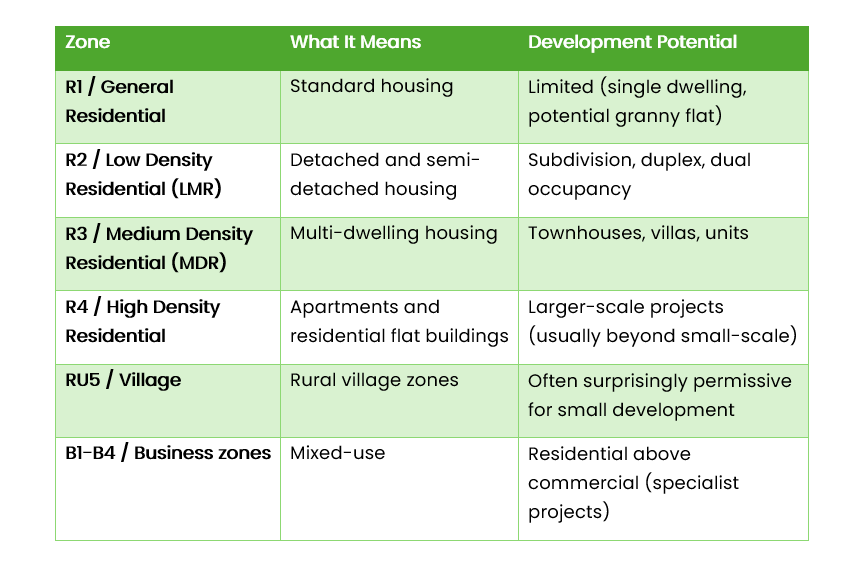 If the zoning does not permit what you want to build, the site does not work. Do not buy land hoping for a rezoning — that is speculation, not development.
Step 2: Read the Development Control Plan (DCP)
The DCP is the council's detailed rulebook. It tells you the specific requirements for development in each zone:
- Minimum lot size (the smallest lot you can create after subdivision)
- Maximum site coverage (what percentage of the lot the building can cover)
- Setbacks (how far the building must be from boundaries)
- Height limits (maximum building height in metres and storeys)
- Floor Space Ratio (FSR) (maximum total floor area relative to lot size)
- Parking requirements (how many car spaces per dwelling)
- Landscaping requirements (minimum percentage of soft landscaping)
- Private open space (minimum outdoor space per dwelling)
These rules determine the physical envelope of what you can build. Your architect designs within these constraints.
Step 3: Assess the Physical Site
Not every site that looks good on paper works in reality. Walk the site and check:
Block Dimensions and Shape
- Width: Most councils require a minimum lot width of 12 to 15 metres for subdivision. Wider is better.
- Depth: Deeper blocks provide more design flexibility.
- Shape: Regular rectangles are easiest to develop. Irregular shapes (pie-shaped, very narrow, triangular) create design challenges and increase costs.
Topography
- Flat sites are cheaper to develop — less excavation, simpler foundations.
- Sloping sites add cost (retaining walls, split-level designs, additional engineering) but can sometimes create value through better street presence or views.
- Flood-prone land should generally be avoided for small-scale development. Check council flood maps.
Access
- Corner lots are highly desirable for subdivision because they provide dual street access, allowing separate driveways for each lot.
- Rear access via a laneway is valuable for the same reason.
- Battle-axe lots (accessed via a long driveway) can work but often have minimum driveway width requirements that reduce the usable site area.
Existing Improvements
- An older house on a large block is a classic development site. The house value is low, but the land value supports development.
- Be cautious of heritage-listed buildings — demolition may not be possible.
- Check for significant trees. Many councils protect trees above a certain size, and removal permits can be difficult or impossible to obtain.
Step 4: Determine the Highest and Best Use
This is the critical question: what is the most profitable thing you can do with this site?
The options typically include:
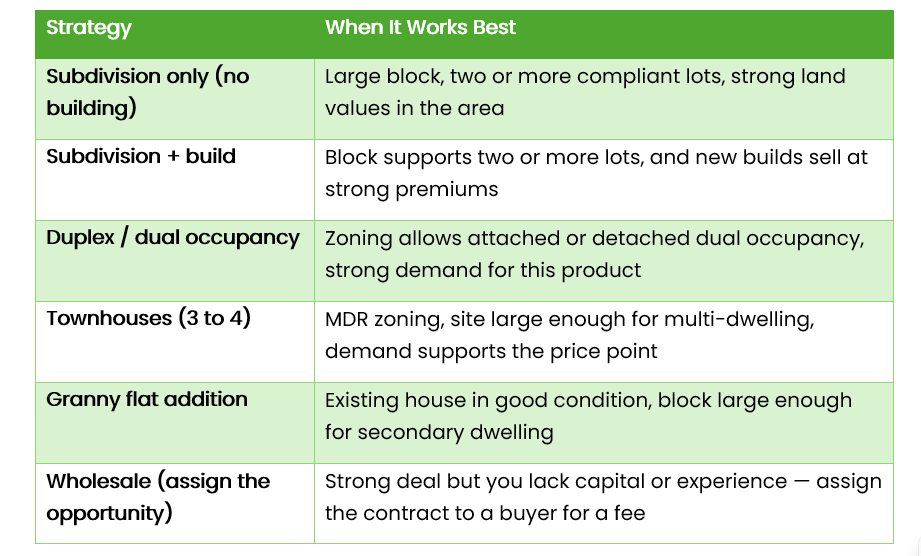
The best-use analysis considers:
- What does the zoning allow? (Maximum permitted density)
- What will the market pay for? (Comparable sales for the end product)
- What will it cost? (Construction, approvals, holding costs)
- What produces the highest profit? (Revenue minus costs)
Sometimes the highest and best use is not the most complex option. A simple subdivision producing $120,000 profit may be smarter than a four-townhouse development producing $180,000 profit but carrying three times the risk and complexity.
Step 5: Analyse the Comparable Sales
Before you commit to any site, you need evidence that the end product will sell at the price you need.
How to run a comparable analysis:
- Search sold properties within 1 to 2 kilometres of the site
- Filter for properties similar to what you plan to build (same bedroom count, similar size, similar age/condition)
- Focus on sales within the last 6 months (12 months maximum)
- Find at least 3 comparable sales
- Adjust for differences (slightly bigger = slightly higher price, etc.)
If you cannot find 3 comparable sales that support your target sale price, your revenue estimate is not reliable. Either adjust your numbers down or reconsider the project.
Step 6: Talk to a Town Planner
Before you buy anything, spend 30 to 60 minutes with a local town planner. They can tell you:
- Whether your proposed development is likely to be approved
- Any site-specific constraints you may have missed (easements, heritage, flooding, bushfire)
- What council is currently approving in that area
- Potential issues with neighbour objections
- Whether a Complying Development pathway is available (faster and cheaper than DA)
A town planner consultation costs $500 to $1,500 and can save you hundreds of thousands of dollars by steering you away from sites that will not get approval.
The Quick Site Assessment Checklist
Use this checklist to quickly assess whether a site is worth investigating further:
- Zoning allows the development type you want
- Block size meets minimum lot requirements for subdivision (if applicable)
- Block width is 12 metres or more
- Site is relatively flat or slope is manageable
- No heritage listing on existing buildings
- No significant protected trees
- Not in a flood zone
- Street access is adequate (corner lot or dual access preferred)
- Comparable sales support your target revenue
- Quick feasibility shows minimum 20 percent margin
- Town planner confirms the concept is approvable
If a site fails on zoning, minimum lot size, or comparable sales, stop. No further analysis is needed.
FAQs
How many sites should I analyse before finding a good one?
Most developers analyse 20 to 50 sites before finding one that meets all their criteria. The discipline of filtering out bad sites is what protects you. You should be looking at 10 to 20 potential sites per week.
What is the most common mistake when analysing sites?
Falling in love with a property before checking the numbers. Always run the feasibility first. If the numbers do not work, it does not matter how much you like the site.
Can I check zoning online?
Yes. Every state has an online planning portal where you can check zoning for any property. The information is free and publicly available.
What block size do I need for subdivision?
This varies by council and state. Most councils require a minimum of 400 to 600 square metres per lot after subdivision, plus minimum lot widths of 10 to 15 metres. Always check your specific council's DCP.
Should I buy a site with an existing tenant?
You can, but factor in the cost and time of managing the tenancy and potentially ending the lease before development can begin. Vacant possession is simpler.
Is it better to develop in metro or regional areas?
Both can work. Metro areas typically have higher land costs but stronger demand and higher end values. Regional areas have lower entry costs and often larger blocks, but demand may be more limited. The key is running the feasibility for the specific site and market.
Think Property Club | thinkpropertyclub.com.au
Want to learn how to analyse deals like this every week?
Think Property Club teaches you how to spot opportunities, run feasibilities, and make confident decisions — using the same system that has helped students create over $50 million in property profits.
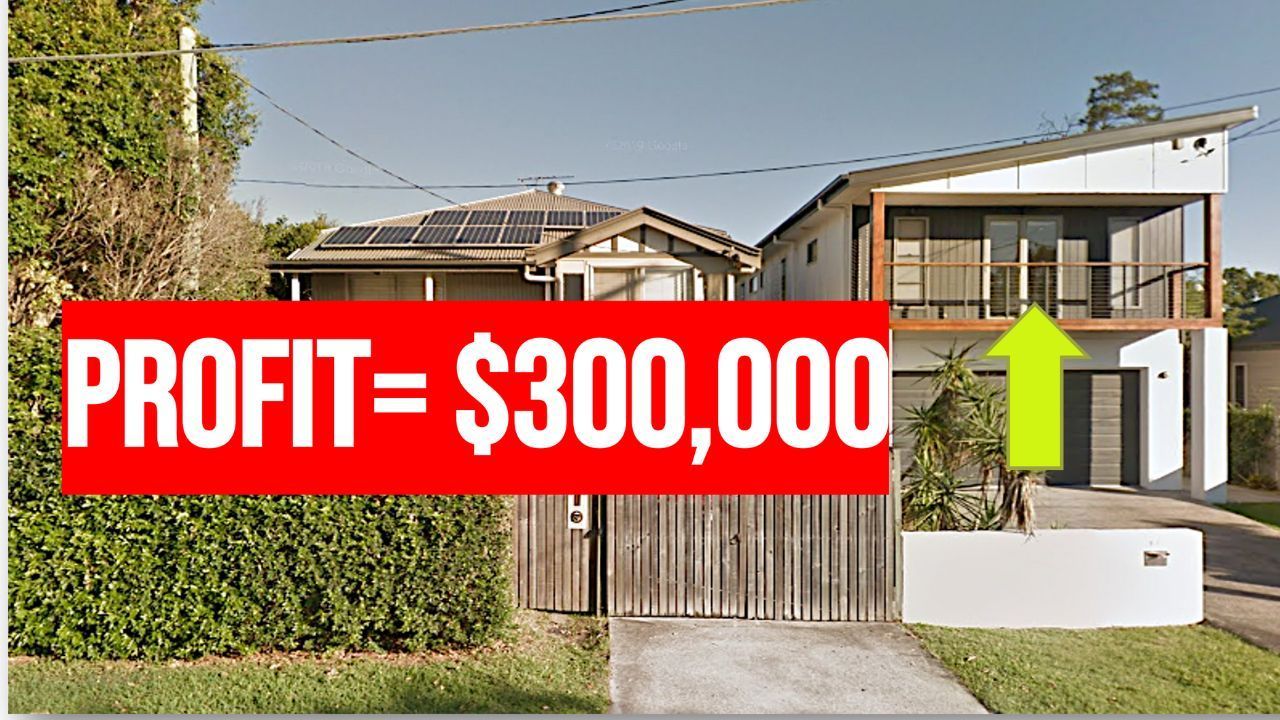
Discover the simple process behind $50M in property
Learn how to swipe this strategy to generate an extra $100K+ per year on the side, without using your own money.
Recent Posts
Categories
All Categorieshow to analyse a development site
property development australia
property development costs australia
property development finance australia
property development guide australia
property development process australia
property development vs buy and hold
