
Joint Venture Property Development Explained: How to Develop Without Your Own Money
What Is a Joint Venture in Property Development?
A joint venture (JV) is a partnership between two or more parties to develop property together. Each party contributes something different — typically one provides the capital and the other provides the deal, the knowledge, and the project management.
This is how many Australians enter property development without using their own money. The capital partner funds the project. The development partner (you) manages the deal from start to finish. Profits are shared according to an agreed split.
Why Joint Ventures Work
Property development requires two things: a good deal and capital to execute it.
Most people have one but not the other.
- People with capital often lack the knowledge to find, analyse, and manage development deals. They want returns but do not want to learn the intricacies of zoning, feasibility, and construction management.
- People with knowledge (the deal finders, the development strategists) often lack the upfront capital to purchase land and fund construction. But they know how to find deals that produce strong returns.
A JV brings both together. The capital partner gets a return they could not achieve on their own. The development partner gets to execute deals without personal financial risk.
How a Typical JV Is Structured
The Capital Partner Provides:
- Deposit and purchase funds for the land
- Construction costs (or guarantees the construction loan)
- Holding costs during the project
- Any required equity contribution for bank lending
The Development Partner Provides:
- The deal (finding and securing the development site)
- Feasibility analysis and due diligence
- Project management (coordinating architects, builders, town planners, surveyors)
- All council approvals and compliance
- Sales management
- Ongoing decision-making and problem-solving throughout the project
Profit Split
The most common JV split is 50/50 after all costs are recovered. This means:
- All capital invested by the capital partner is repaid first
- All project costs are settled
- The remaining profit is split 50/50
Some variations include: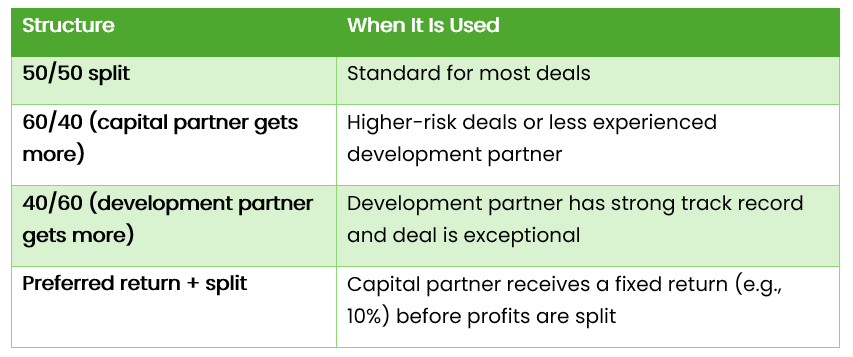 The exact structure depends on the deal, the risk, and the relationship between partners.
The Legal Structure
JVs should always be formalised through a legal agreement. Do not do a JV on a handshake.
Common JV structures in Australia:
1. JV Agreement (Unincorporated)
- Two parties sign a JV agreement that sets out roles, contributions, and profit sharing
- The property is typically held in one party's name (or a trust) with the JV agreement protecting both parties
- Simpler to set up
- Most common for first-time JVs
2. Unit Trust
- A trust is established to hold the development
- Each party holds units in the trust proportional to their contribution and agreed split
- Provides clearer legal separation
- Better for larger or more complex deals
3. Company Structure
- A purpose-built company (SPV — Special Purpose Vehicle) is created for the development
- Each party holds shares
- Offers limited liability but comes with higher setup and compliance costs
- Common for larger projects
Always use a solicitor experienced in property JVs to draft the agreement. Key terms to include:
- Roles and responsibilities of each party
- Capital contributions and draw-down schedule
- Decision-making process (who approves what)
- Profit distribution methodology
- Exit provisions (what happens if one party wants out)
- Default provisions (what happens if one party does not perform)
- Dispute resolution process
- Insurance requirements
- GST and tax treatment
How to Find a JV Capital Partner
This is one of the most common questions from new developers. Here is where capital partners typically come from:
1. Your Personal Network
Family, friends, colleagues, and acquaintances who have capital but lack the knowledge or time to develop property. Many people have superannuation, savings, or equity in their home but no vehicle to put it to work.
2. Other Property Students and Investors
People who understand property but prefer a passive role. They recognise a good deal when they see one and want to participate without managing the project.
3. Professional Investor Networks
Accountants, financial advisers, and solicitors often have clients looking for property investment opportunities. Building relationships with these professionals can provide a pipeline of capital partners.
4. Existing Developer Networks
Once you complete your first deal, capital partners find you. Success breeds trust. A completed project is the best pitch document you will ever have.
The key to attracting capital partners: Confidence, clarity, and numbers. When you can present a feasibility study, explain the deal structure, show comparable evidence, and demonstrate you have the specialist team in place, people with capital will take you seriously.
Worked Example: JV Subdivision Deal
The Deal:
- 800 sqm corner block with an older home, zoned R2 (low density residential)
- Purchase price: $480,000
- Strategy: Demolish existing home, subdivide into two lots, sell both as vacant land
Capital Partner Contributes:
- Purchase price: $480,000
- Stamp duty: $18,000
- Demolition: $15,000
- Professional fees (surveyor, town planner, engineer): $18,000
- Council fees: $8,000
- Holding costs (rates, interest, insurance for 8 months): $22,000
- Sales costs: $16,000
- Total investment: $577,000
Development Partner Contributes:
- Finding and securing the deal
- Managing the entire subdivision process
- Coordinating all specialists
- Managing the sale of both lots
Revenue:
- Lot 1 (420 sqm): $380,000
- Lot 2 (380 sqm): $350,000
- Total revenue: $730,000
Profit Calculation:
- Revenue: $730,000
- Total costs: $577,000
- Profit: $153,000
- Capital partner receives: $577,000 (return of capital) + $76,500 (50% profit)
- Development partner receives: $76,500 (50% profit)
The capital partner earns a 13.3 percent return on their investment in 8 months. The development partner earns $76,500 without investing any of their own money.
Common JV Mistakes to Avoid
- No written agreement. Every JV needs a legally binding agreement drafted by a solicitor. Verbal agreements are not enforceable and lead to disputes.
- Unclear roles. Both parties must know exactly who is responsible for what. Ambiguity creates conflict.
- Wrong partner. Not every person with money is a good JV partner. Look for someone who understands property, is patient with timelines, and trusts the process.
- Overcommitting. Do not promise returns you cannot guarantee. Present the feasibility honestly and let the numbers speak for themselves.
- No exit plan. The agreement must address what happens if the project takes longer than expected, if one party wants to exit, or if the market changes.
FAQs
Do I need my own money to enter a JV?
No. That is the entire point of a JV for the development partner. You contribute the deal, the knowledge, and the project management. The capital partner contributes the funds.
How do I protect myself in a JV?
Through a formal legal agreement drafted by a solicitor. The agreement should cover roles, contributions, profit splits, decision-making, disputes, and exit provisions. Additionally, ensure you have appropriate insurance coverage.
What return does a capital partner typically expect?
Most capital partners in property JVs expect a total return of 15 to 30 percent on their investment over the project duration. The exact expectation depends on the deal risk, the timeframe, and the development partner's track record.
Can I do a JV using my self-managed super fund (SMSF)?
Potentially, but there are strict rules around SMSF property investment. You need specialist SMSF and tax advice before structuring a JV with super fund capital.
What if the project makes a loss?
The JV agreement should address this. Typically, the capital partner bears the financial loss (since they provided the capital), and the development partner's loss is their time and effort. However, this depends entirely on the terms of your specific agreement.
How do I approach someone about a JV?
Lead with the deal, not the ask. Present the feasibility study, the comparable sales, the specialist team, and the projected return. When people see a well-structured opportunity with clear numbers, the conversation about funding flows naturally.
Think Property Club | thinkpropertyclub.com.au
Want to learn how to analyse deals like this every week?
Think Property Club teaches you how to spot opportunities, run feasibilities, and make confident decisions — using the same system that has helped students create over $50 million in property profits.
Discover the simple process behind $50M in property
Learn how to swipe this strategy to generate an extra $100K+ per year on the side, without using your own money.
Recent Posts
Categories
All Categorieshow to analyse a development site
property development australia
property development costs australia
property development finance australia
property development guide australia
property development process australia
property development vs buy and hold
